
When Architecture Begins With Subtraction
Most landmarks are assembled piece by piece. These extraordinary creations were produced by doing the opposite: removing stone until a temple, statue, church, or monument emerged. Some are true freestanding monoliths, while others remain connected to cliffs or bedrock. Together, they demonstrate how entire mountains could become architecture in the hands of determined sculptors.
Kailasa Temple, India
Kailasa Temple at Maharashtra’s Ellora Caves looks constructed, yet its courtyards, columns, shrines, stairways, and sculptures were excavated from one continuous mass of basalt. Artisans worked downward through the rock, removing material instead of laying foundations and stacking blocks.
Also known as Cave 16, this eighth-century Hindu sanctuary was designed to evoke Mount Kailash, the sacred home of Shiva. It is the largest monolithic temple at Ellora and the complex’s greatest display of structural ambition. Visitors can explore more context through UNESCO’s Ellora Caves profile.
Church of Saint George, Ethiopia
From ground level, Biete Ghiorgis can initially appear to be a cross-shaped trench. Look down, however, and an entire church becomes visible inside it. Workers carved the building from living volcanic rock, hollowing its interior and leaving its roof, walls, windows, and columns connected.
Biete Ghiorgis is the most recognizable of Lalibela’s 11 medieval monolithic churches. Its cruciform plan and sunken position make the surrounding earth feel like part of the design. The wider complex, described in UNESCO’s guide to Lalibela, remains an important place of Ethiopian Orthodox worship and pilgrimage.
Al-Khazneh, Jordan
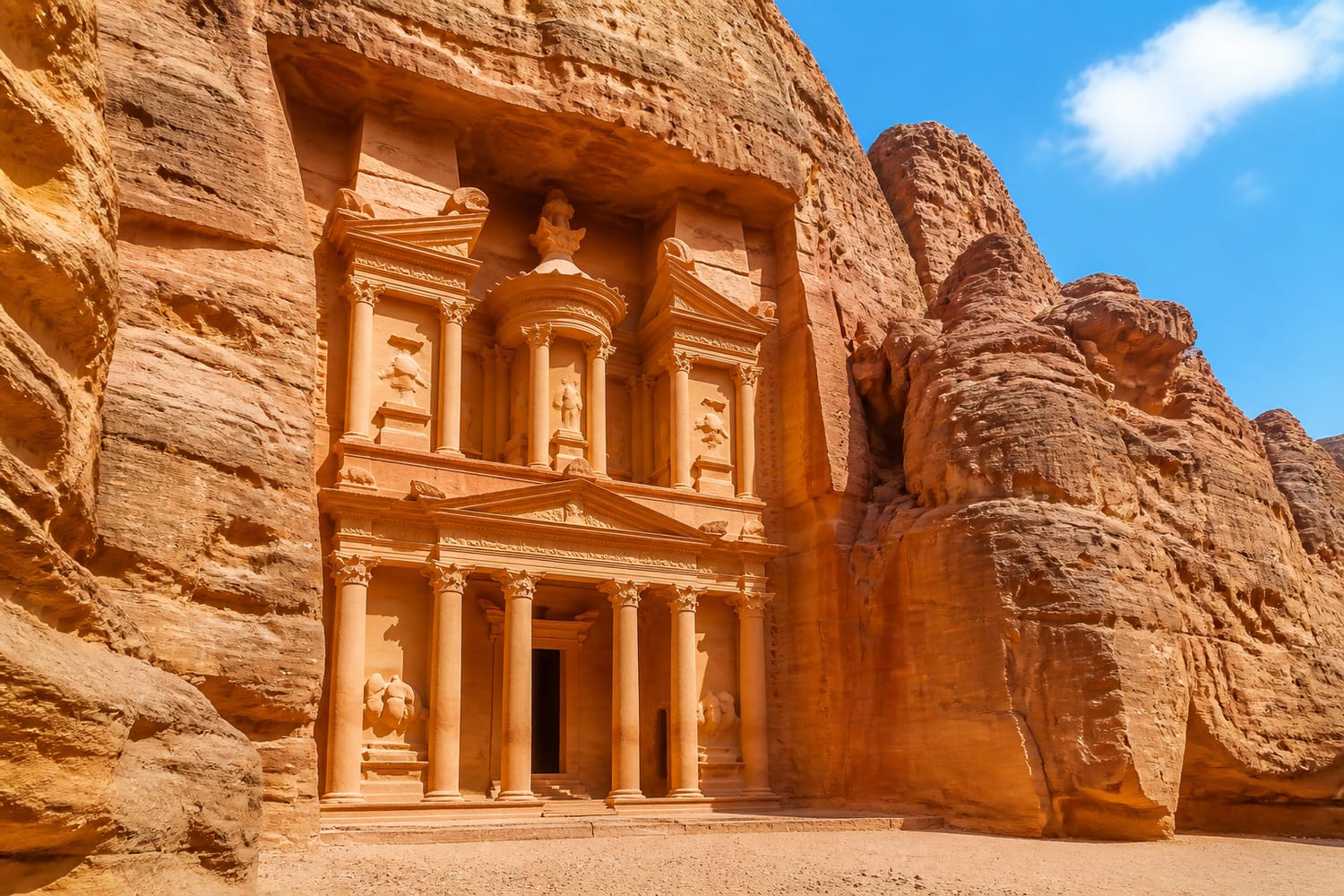
After walking through Petra’s narrow Siq, travelers encounter one of history’s great architectural reveals: Al-Khazneh, or the Treasury. Its columns, pediments, niches, and sculptural details were cut directly into a towering sandstone cliff by Nabataean craftspeople.
Only the chambers behind the façade are hollow. The majestic exterior remains part of the mountain, making it a monumental example of rock-cut rather than freestanding architecture. Petra itself is half-built and half-carved, with numerous tombs and temples sculpted into the surrounding stone. Test your knowledge with Tour Trivia’s question about the location of Petra.
The Great Sphinx of Giza, Egypt
Unlike the nearby pyramids, which were assembled using countless blocks, the Great Sphinx was carved directly from the limestone bedrock of the Giza Plateau. Its lion’s body and royal human head have watched over the landscape for approximately 4,500 years.
Evidence generally connects the monument with Pharaoh Khafre, builder of Giza’s second pyramid. Although stone and mortar were later added during repairs, the Sphinx’s core remains one enormous piece of the plateau itself—a natural outcrop transformed into a royal guardian.
Abu Simbel, Egypt
Ramses II’s Great Temple at Abu Simbel was originally excavated directly into solid rock during the 13th century BCE. Four seated statues of the pharaoh dominate its entrance, while chambers, pillars, reliefs, and sacred spaces extend deep inside the former cliff.
There is one fascinating complication: Abu Simbel is no longer technically a single continuous rock carving. To protect it from the reservoir created by the Aswan High Dam, engineers cut the temples into more than 1,000 blocks and reconstructed them within an artificial cliff on higher ground.
Leshan Giant Buddha, China
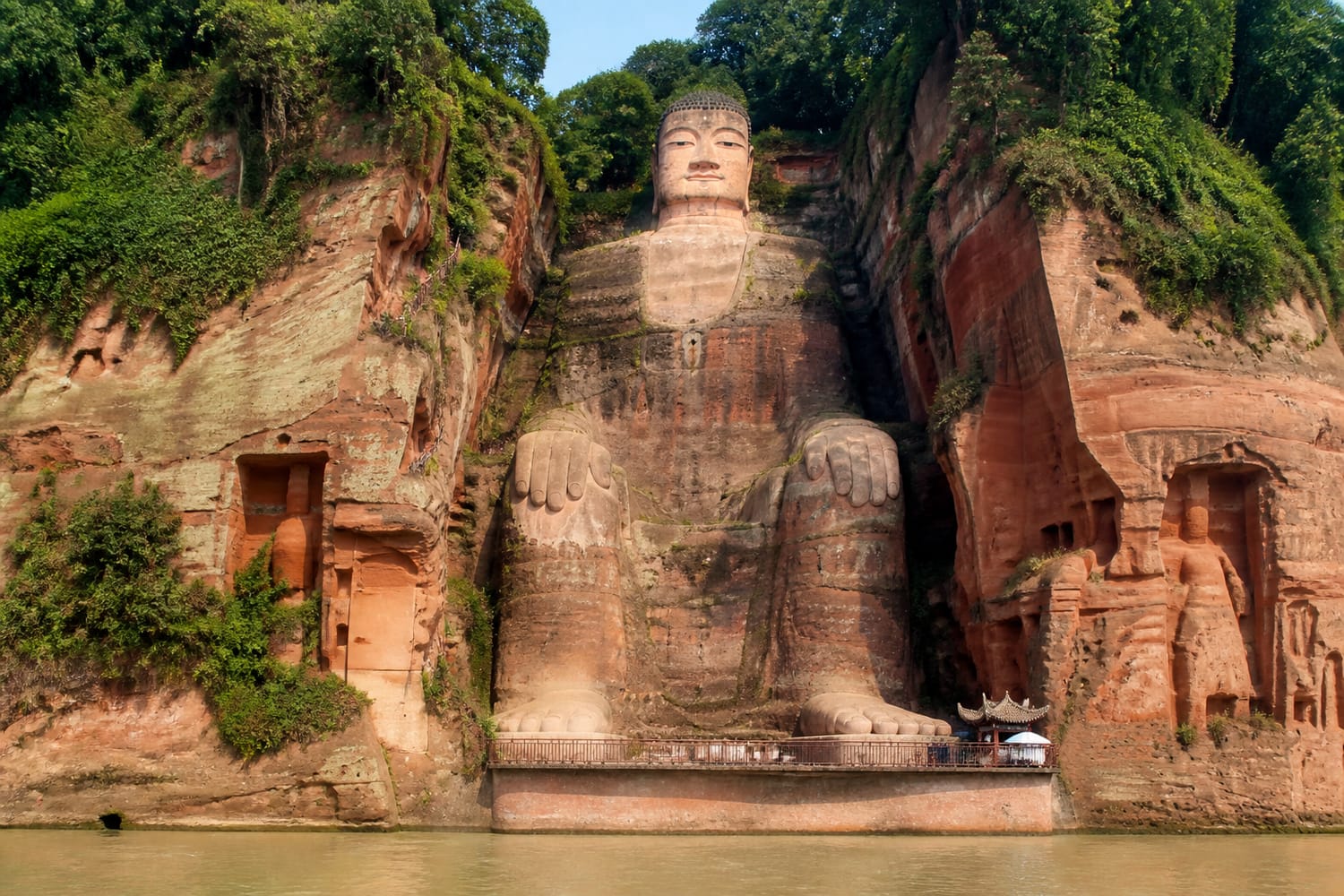
At the meeting point of three rivers in China’s Sichuan Province, a seated Buddha rises from the red sandstone hillside. The Leshan Giant Buddha stands 71 meters tall and was carved during the eighth century, with the cliff itself providing the figure’s body.
The statue’s scale is difficult to appreciate until visitors notice people walking near its enormous feet. Ingenious drainage channels concealed within the hair, clothing, and body helped redirect rainwater, showing that its creators approached the project as both sculpture and engineering.
Mount Rushmore, United States
Mount Rushmore transformed part of South Dakota’s Black Hills into a colossal portrait gallery. The faces of George Washington, Thomas Jefferson, Theodore Roosevelt, and Abraham Lincoln were carved into the mountain’s granite between 1927 and 1941.
Dynamite removed most of the unwanted stone before drillers and carvers refined the presidential features. The monument remains part of the mountain rather than a detached sculpture, although fractures naturally divide the granite into separate geological blocks. See if you know where Mount Rushmore is located.
The Moai of Rapa Nui
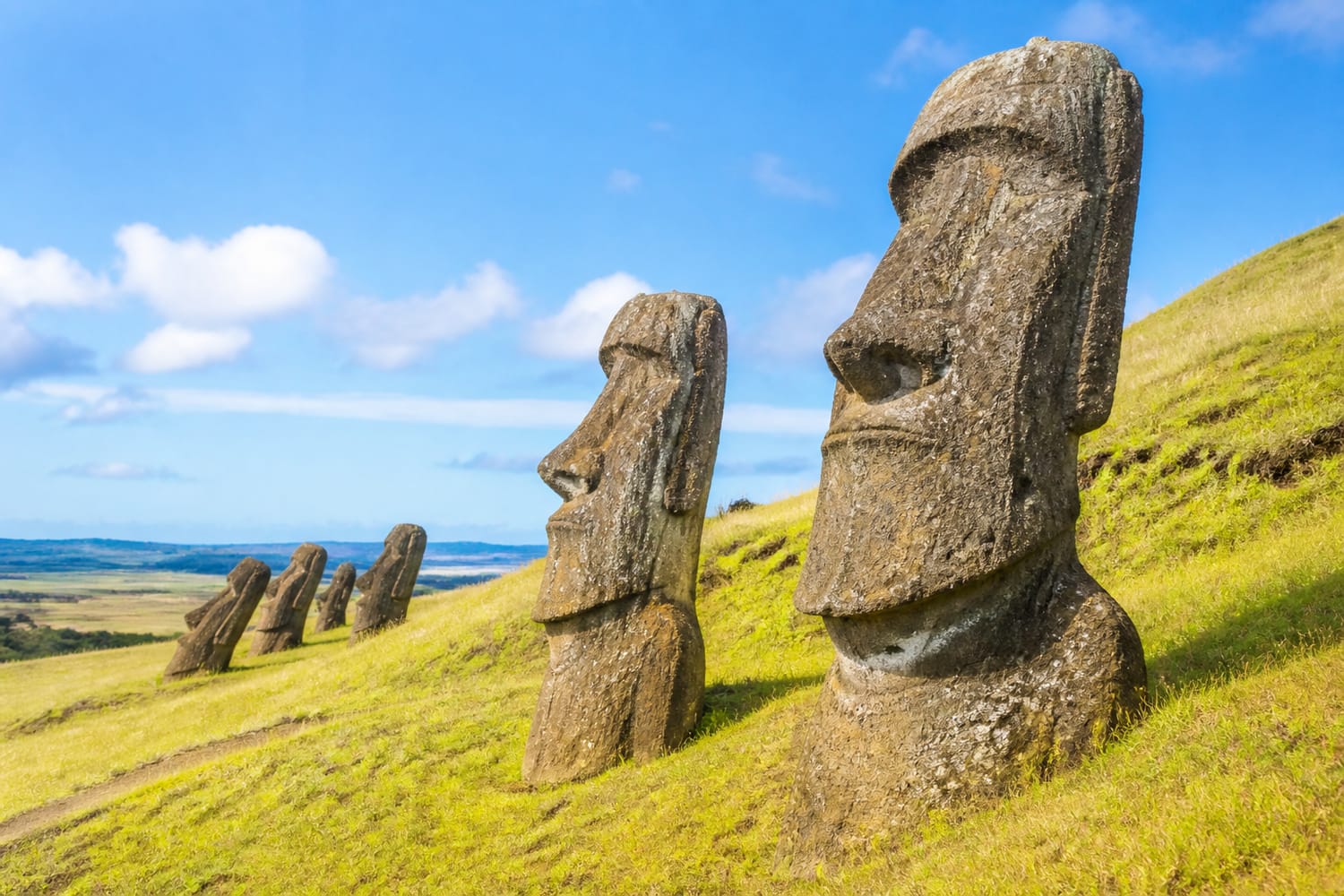
The moai of Rapa Nui, commonly called Easter Island, are individual monoliths representing revered ancestors. Most were carved from single blocks of volcanic tuff at the Rano Raraku quarry before being transported across the island and raised on ceremonial platforms known as ahu.
Some statues originally wore separate red-stone topknots, but their massive bodies were each shaped from one piece of rock. Approximately 900 moai have been identified, including unfinished examples that remain attached to the quarry. Try Tour Trivia’s moai island challenge before checking the answer.
Gommateshwara, India
Standing above Shravanabelagola in Karnataka, the serene statue of Gommateshwara depicts Bahubali, an important figure in Jain tradition. The approximately 18-meter figure was carved from a single block of granite and consecrated in 981 CE.
The statue’s calm expression contrasts with its immense scale. Vines carved around its legs symbolize the long, motionless meditation associated with Bahubali’s renunciation. Reaching it requires climbing hundreds of steps cut into Vindhyagiri Hill, reinforcing the sense of pilgrimage.
The Unfinished Obelisk, Egypt
Not every monolithic masterpiece was completed. In an ancient quarry at Aswan, an enormous obelisk remains partially connected to the granite bedrock from which workers attempted to free it.
Probably commissioned during the reign of Hatshepsut, it was abandoned after cracks appeared in the stone. Had it been completed, the obelisk would have stood around 42 meters tall and weighed more than 1,100 tons. Its unfinished state offers a rare look at how ancient Egyptians shaped monumental stone before transportation.
Monuments That Remain Part of the Earth
These landmarks blur the boundary between the natural and human-made worlds. Their creators could not replace a faulty block or easily revise a design; every strike risked permanently damaging the monument.
That unforgiving process is precisely what makes monolithic architecture so remarkable. Whether carved from a movable block, a quarry floor, or an entire mountainside, each landmark preserves an astonishing moment when people looked at solid rock and imagined something hidden inside it.