
Some of the world’s most unforgettable views are not reached by elevator, cable car, or scenic road. They wait at the top of ancient stairways, where every step feels like a small journey through time. These staircases were often built for reasons far more important than sightseeing: worship, defense, trade, pilgrimage, or royal ceremony. Yet today, they reward travelers with sweeping landscapes, dramatic cityscapes, and a deeper appreciation for the people who carved, stacked, and climbed them centuries ago.
For curious travelers and history lovers, ancient stairways offer the perfect mix of challenge and wonder. They make you slow down. They make you look closely at the stones beneath your feet. And when you finally reach the top, the view feels earned. Here are some remarkable ancient stairways around the world that lead to incredible views.
The Stairs of Machu Picchu, Peru
High in the Andes Mountains, Machu Picchu is famous for its terraces, temples, and misty mountain setting. But its stairways are just as impressive as its postcard views. Built by the Inca in the 15th century, the stone steps throughout the site connect plazas, agricultural terraces, sacred areas, and lookout points with astonishing precision.
The Inca did not use mortar, yet many of these stones still fit tightly together after centuries of rain, earthquakes, and heavy foot traffic. Climbing through Machu Picchu can feel like moving through a stone maze suspended between peaks. The surrounding mountains rise sharply on all sides, with Huayna Picchu and Machu Picchu Mountain offering especially dramatic perspectives.
For travelers who take on the steep stairways up Huayna Picchu, the reward is a bird’s-eye view of the entire ancient city. From above, Machu Picchu looks almost unreal, a carefully planned stone settlement resting on a green ridge above the Urubamba River.
The Great Wall Stairways, China
The Great Wall of China is not one single staircase, but many sections include ancient stone steps that climb steeply over mountains and ridgelines. Some stretches are gentle and restored, while others are wild, uneven, and physically demanding. Either way, the stairways of the Great Wall remind visitors that this was not just a monument; it was a military defense system built across some of the most rugged terrain in the world.
Sections near Beijing, such as Mutianyu and Jinshanling, offer some of the most memorable climbs. The steps vary in height, sometimes forcing visitors to slow down and focus on each movement. Watchtowers appear along the route, giving climbers a place to pause and take in the scenery.
From the higher towers, the wall snakes across the hills like a stone dragon. Forests, mountains, and distant valleys stretch in every direction. The view is especially beautiful in autumn, when the surrounding hills turn gold and red.
Sigiriya’s Stairways, Sri Lanka
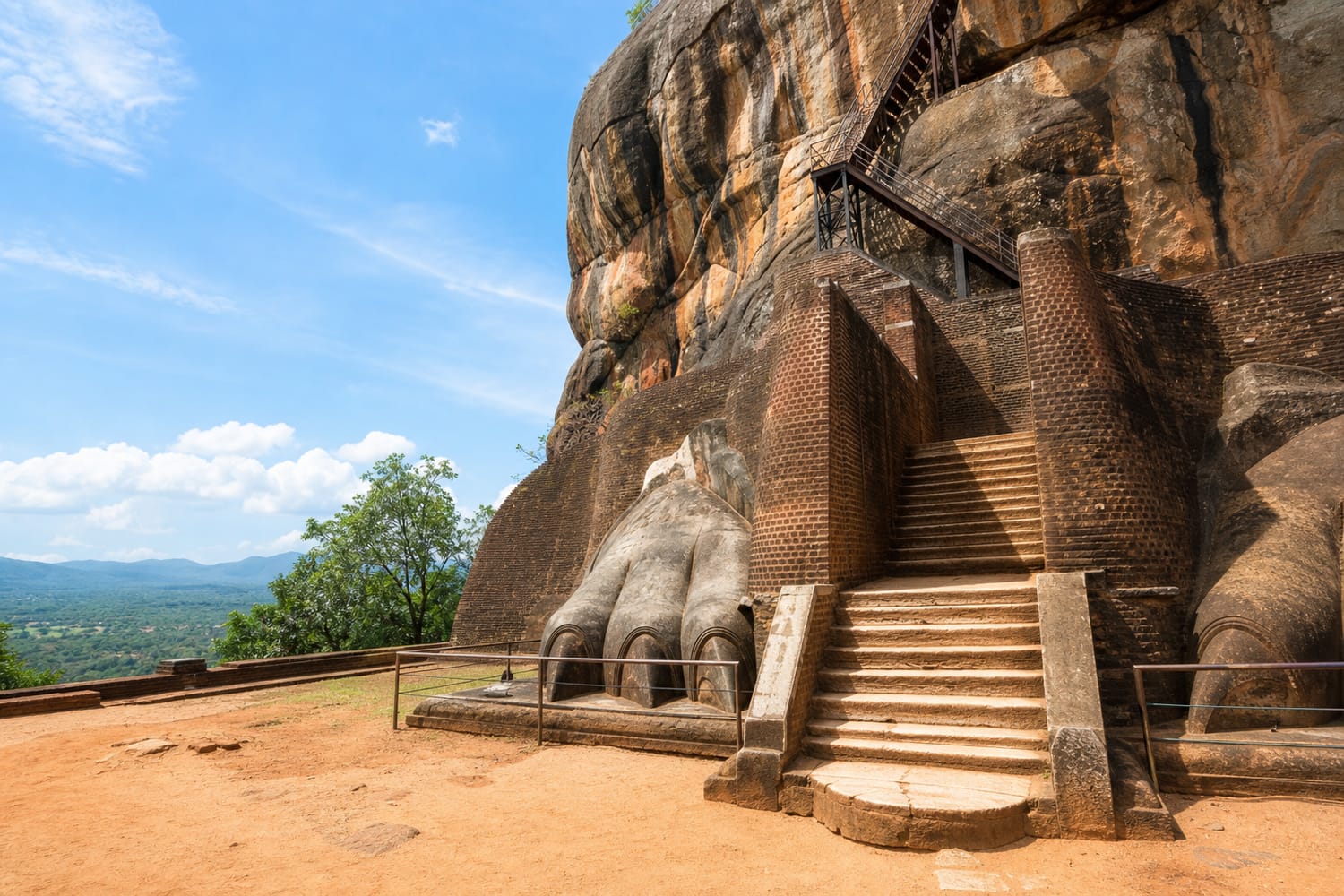
Sigiriya, also known as Lion Rock, rises dramatically from the central plains of Sri Lanka. This massive rock fortress was transformed in the 5th century by King Kashyapa, who built a palace complex at its summit. To reach the top, visitors climb a series of ancient and modern stairways that pass gardens, frescoes, terraces, and the remains of a giant lion-shaped gateway.
The final ascent begins near two enormous lion paws carved from stone. Although the full lion structure no longer survives, the paws give a sense of how awe-inspiring the entrance must once have been. The climb is steep, and the height can be dizzying, but the reward is spectacular.
At the summit, the ruins of the palace open onto a panoramic view of forests, lakes, villages, and distant mountains. Sigiriya’s stairways are not only a route upward; they are part of a carefully designed royal experience meant to impress, intimidate, and inspire.
The Spanish Steps, Italy
Not every ancient or historic stairway leads to a mountaintop. Some lead to unforgettable urban views. Rome’s Spanish Steps, completed in the 18th century, are younger than many stairways on this list, but they connect travelers with one of the most historic cityscapes in the world. Built between the Piazza di Spagna and the Trinità dei Monti church, the steps have long been a gathering place for artists, writers, locals, and visitors.
Climbing the 135 steps offers a gradually expanding view of Rome’s rooftops, domes, and lively streets. From the top, the city feels both grand and intimate. The stairway itself is elegant, with curves, terraces, and landings that invite people to pause rather than hurry.
The Spanish Steps are a reminder that stairways can shape the rhythm of a city. They are not only pathways but public stages, places where daily life and history meet.
The Steps of Petra, Jordan
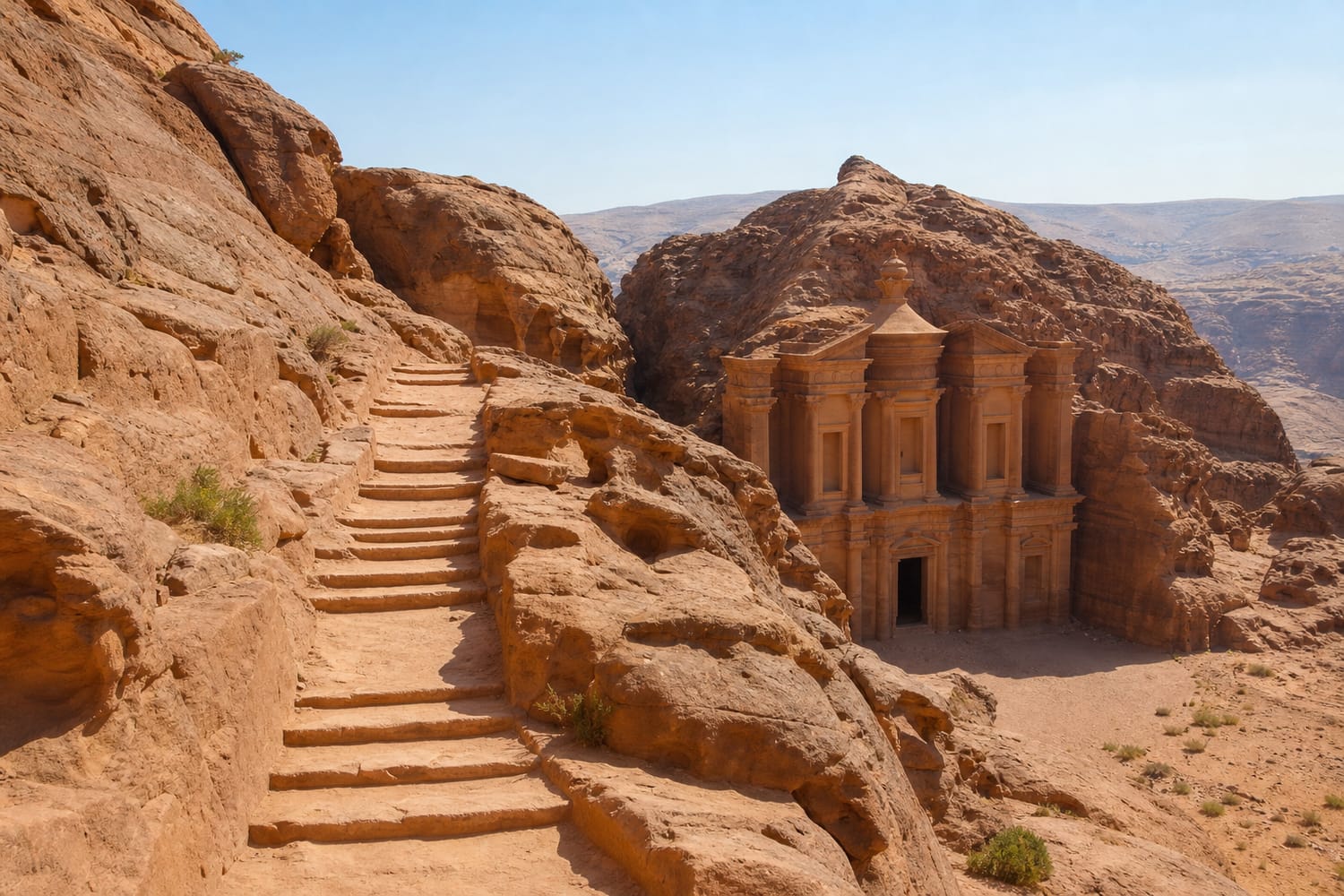
Petra, the ancient Nabataean city carved into rose-colored cliffs, is filled with stairways that lead to tombs, temples, high places, and hidden overlooks. The most famous climb is the route to the Monastery, or Ad Deir, one of Petra’s largest and most impressive monuments.
Reaching the Monastery requires climbing hundreds of rock-cut steps through a rugged canyon landscape. Along the way, travelers pass cliffs, caves, small stalls, and glimpses of desert scenery. The steps are worn and uneven, shaped by centuries of use by traders, pilgrims, and now modern visitors.
When the Monastery finally comes into view, carved directly into the sandstone cliff, the effort feels completely worthwhile. A little farther beyond the monument, lookout points offer sweeping views over the mountains and valleys of southern Jordan. Petra’s stairways make the ancient city feel like a place of discovery, where every climb reveals another secret.
Angkor Wat’s Temple Stairs, Cambodia
The temple complexes of Angkor in Cambodia are filled with symbolic stairways. At Angkor Wat, steep steps lead upward to central towers designed to represent Mount Meru, the sacred mountain in Hindu and Buddhist cosmology. Climbing these stairs was not meant to be easy. Their steepness reflected the difficulty of reaching the divine.
Today, visitors who climb to the upper levels of Angkor Wat are rewarded with views over courtyards, galleries, lotus-shaped towers, and the surrounding forest. The temple’s scale becomes clearer from above, revealing the careful symmetry and spiritual design behind its construction.
Other temples in the Angkor region, such as Phnom Bakheng and Pre Rup, also feature ancient stairways leading to sunset viewpoints. From these heights, the jungle seems to stretch endlessly, broken by temple towers rising through the trees. The experience is both architectural and atmospheric, especially in the golden light of late afternoon.
The Stairways of Chichén Itzá, Mexico
El Castillo, the famous pyramid at Chichén Itzá, is one of the most recognizable ancient stairways in the Americas. Built by the Maya, this stepped pyramid was designed with extraordinary astronomical precision. Its four staircases each have 91 steps, and when combined with the platform at the top, they total 365, matching the days of the solar year.
Visitors can no longer climb El Castillo, a restriction that helps preserve the monument and protect travelers. Still, its stairways remain visually powerful. During the spring and autumn equinoxes, shadows create the illusion of a serpent descending the pyramid’s staircase, connecting the structure to the feathered serpent deity Kukulcán.
While the view from the top is no longer accessible, the sight of the stairway itself is incredible. Standing at its base, travelers can imagine how the pyramid once dominated ceremonies, festivals, and political life in the ancient Maya city.
The Rock-Cut Steps of Mount Nemrut, Turkey
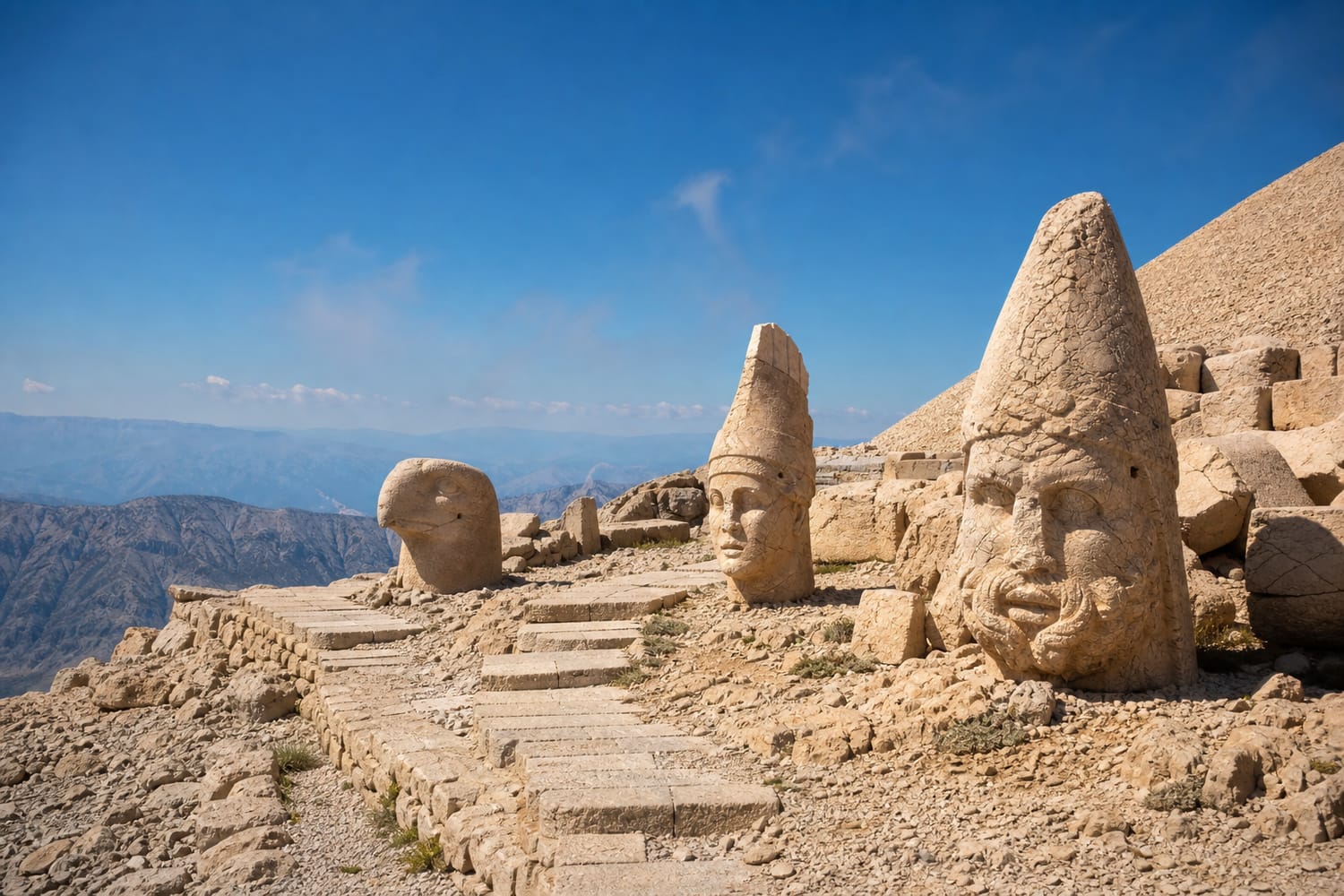
Mount Nemrut in southeastern Turkey is home to one of the most mysterious ancient sites in the world. At its summit sits the tomb-sanctuary of King Antiochus I of Commagene, built in the 1st century BCE. Giant stone heads and seated statues are arranged on terraces near the peak, creating an unforgettable scene.
Reaching the site involves a climb along stone paths and steps, usually before sunrise or sunset. The altitude and rugged landscape add to the sense of anticipation. As travelers ascend, the horizon begins to widen, revealing mountains and valleys across the remote region.
The view from the summit is extraordinary, especially when the first or last light of day illuminates the colossal stone faces. Mount Nemrut’s stairways lead not only to a panorama but to a place where ancient ambition, religion, and landscape merge.
The Sacred Steps of Varanasi, India
Along the Ganges River in Varanasi, ancient stone steps known as ghats descend to the water. Unlike many stairways that lead upward to views, these steps offer a different kind of perspective: one that looks across sacred water, ritual, and daily life. Varanasi is one of the world’s oldest continuously inhabited cities, and its ghats have been central to spiritual practice for centuries.
At sunrise, the view from the steps is unforgettable. Boats drift across the river, pilgrims bathe in the Ganges, priests perform rituals, and the city glows in soft morning light. The stairways create a connection between land and river, the everyday and the eternal.
For visitors, the ghats of Varanasi show that an incredible view is not always about height. Sometimes it is about depth — cultural, spiritual, and human.
Why Ancient Stairways Still Captivate Travelers
Ancient stairways remain powerful because they ask something of us. They require effort, patience, and attention. Unlike modern viewpoints designed for convenience, these routes were shaped by belief, necessity, and imagination. Each step carries traces of the people who came before: builders, soldiers, priests, rulers, merchants, and pilgrims.
For Tour Trivia readers, these stairways offer more than beautiful scenery. They reveal how civilizations interacted with landscapes, how architecture expressed power and faith, and how a simple act like climbing can become a journey through history.
Whether carved into cliffs, stacked across mountains, or descending to sacred rivers, ancient stairways invite travelers to see the world from a higher — or deeper — perspective. And the best part is that the view at the end is only half the reward. The climb itself is the story.