
History Written in Damage
Famous landmarks often appear timeless, but their surfaces tell messier stories. Mysterious holes, missing features, cracks, and pockmarks can reveal ancient building methods, treasure hunting, war, vandalism, or failed restoration. Look closely, and these imperfections become historical evidence—clues that explain not only how monuments were damaged, but how they survived.
The Colosseum’s Metal-Shaped Holes
Rome’s Colosseum is covered with hundreds of irregular holes that make its travertine façade look like a giant stone sponge. They were not designed as ventilation openings, nor were they caused solely by erosion.
Roman builders fitted enormous stone blocks together using iron clamps, employing an estimated 300 tons of metal across the structure. During the Middle Ages, iron was far more valuable than damaged Roman masonry. Scavengers hacked into the stone, extracted the clamps, and melted them down for reuse, leaving deep cavities behind.
A study of the Colosseum’s masonry identifies these marks as clamp sockets. Other portions of the amphitheater disappeared when residents treated the ruin as a convenient quarry. The building therefore bears scars from both metal theft and stone robbing—not simply old age.
The Parthenon’s Explosive Wounds
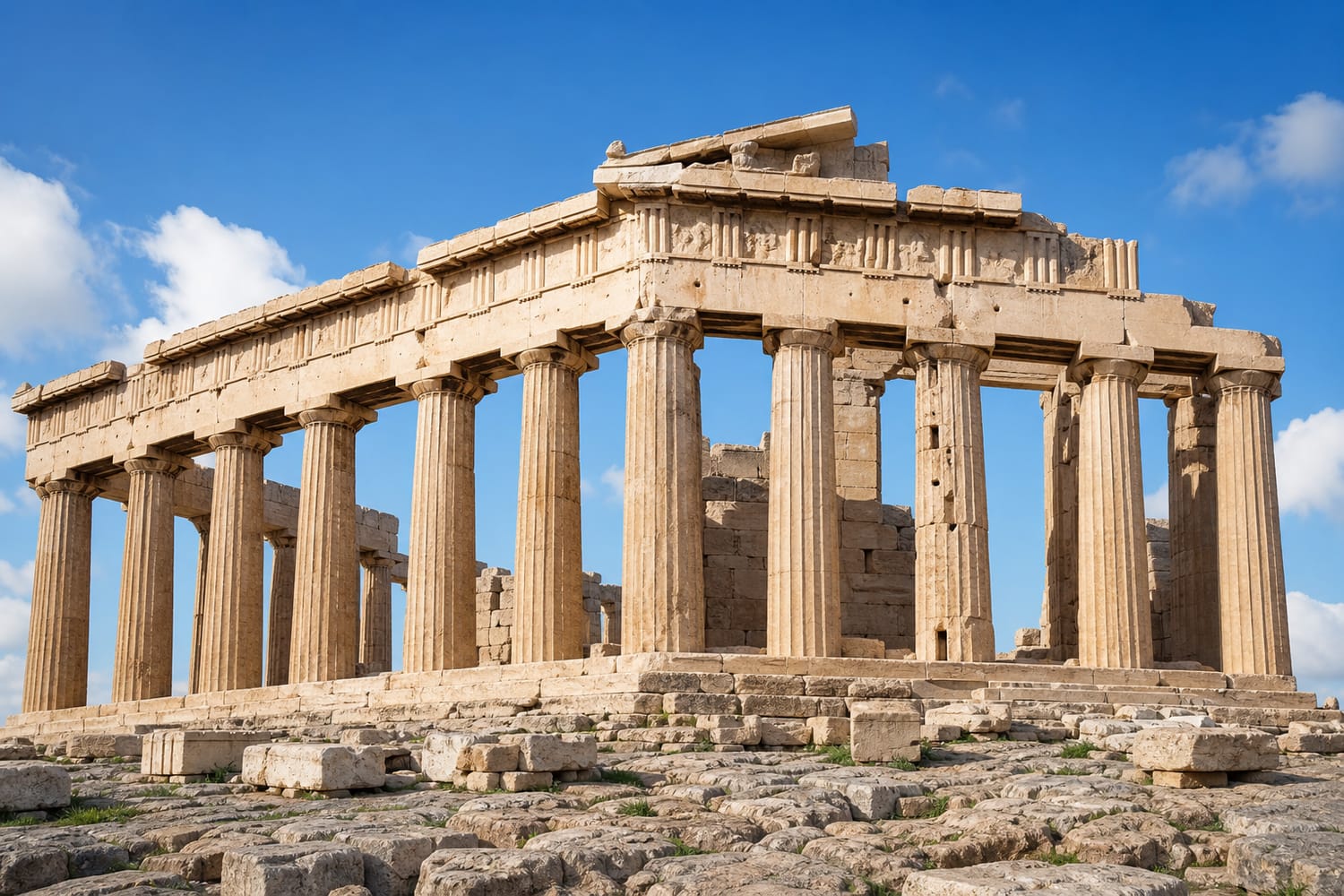
The Parthenon survived more than 2,000 years, serving at different times as a Greek temple, Christian church, mosque, and ammunition store. That last role proved disastrous.
In 1687, Ottoman forces occupying Athens stored gunpowder inside the ancient structure while Venetian troops attacked the Acropolis. A Venetian shell struck the building and ignited the ammunition. The explosion destroyed much of the roof, shattered columns, and scattered marble across the hill.
Some surviving blocks still show impact damage, while gaps in the structure reflect the enormous blast. The Acropolis Museum’s account of the bombardment notes that portions of the western side escaped the worst destruction. Later restoration also caused cracks when uncoated iron clamps rusted, expanded, and split the marble.
The Parthenon is one of several landmarks that nearly disappeared, making its incomplete silhouette a remarkable symbol of survival.
The Great Sphinx’s Missing Nose
Perhaps no absent feature has generated more speculation than the Great Sphinx of Giza’s nose. The most persistent legend blames Napoleon Bonaparte’s soldiers, who supposedly used the monument for cannon practice.
That story falls apart under scrutiny. Danish explorer Frederic Louis Norden depicted the Sphinx without its nose decades before Napoleon arrived in Egypt in 1798. Marks on the face also suggest deliberate chiseling rather than a cannon strike.
Medieval historian al-Maqrizi attributed the damage to Muhammad Sa’im al-Dahr, a 14th-century religious zealot angered by local offerings made to the Sphinx. Many scholars consider intentional vandalism likely, although the culprit cannot be established with complete certainty. The missing nose is therefore both a genuine scar and a warning about how easily folklore can replace evidence.
Petra’s Bullet-Pocked Treasury
Petra’s famous Treasury contains two very different types of holes. Small, regularly arranged openings along its sandstone façade probably supported scaffolding while Nabataean stonemasons carved downward from the cliff. Other marks have a much more dramatic origin.
Local tradition claimed that the large urn high on the façade contained a pharaoh’s treasure. Because the urn is solid stone and nearly impossible to reach, people reportedly fired rifles at it in hopes of breaking it open. The resulting bullet marks remain visible around the urn.
Despite its modern name, the Treasury was probably a royal tomb or ceremonial structure—not a bank filled with gold. Its scars show how legends can physically alter the places that inspire them.
Petra also appears among Tour Trivia’s exploration of ancient ruins across continents.
Stonehenge’s Souvenir Scars
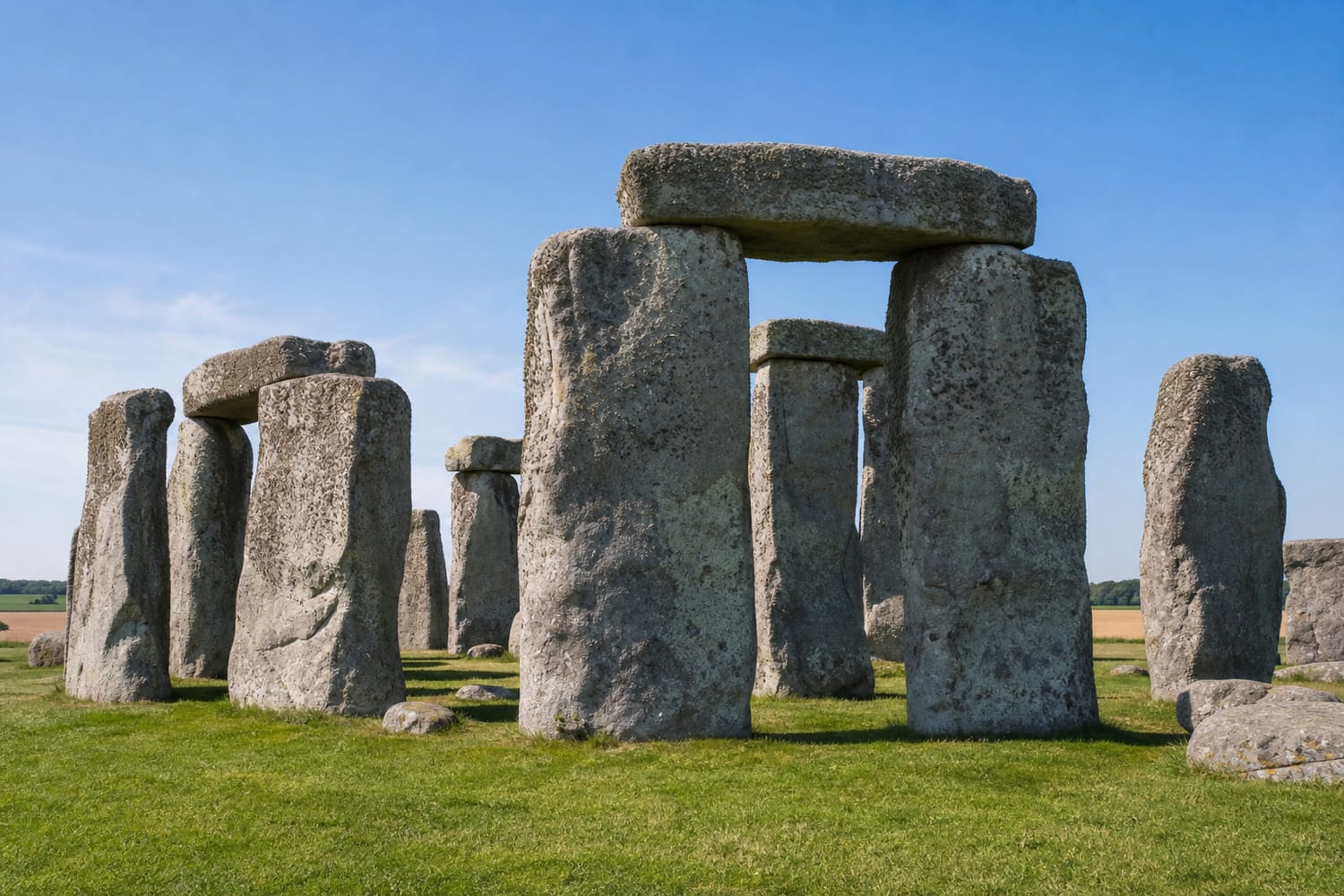
Stonehenge’s weathered surfaces preserve prehistoric carvings, natural erosion, and a less admirable form of travel history. During the 19th century, visitors could approach the stones freely. Some carved their names into the monument, while others chipped away pieces to take home as souvenirs.
The damage became serious enough that an admission charge and police supervision were introduced in 1901. Old and newer graffiti remain on several stones, creating a difficult conservation question: when does vandalism itself become historical?
Stonehenge also carries scars from early repair campaigns. Twentieth-century conservators filled certain cracks with cement, but the material trapped moisture and eventually deteriorated. In 2021, specialists replaced degraded cement with breathable lime mortar, demonstrating how even well-intentioned preservation can leave problems for future caretakers.
The Statue of Liberty’s Shrapnel Damage
The Statue of Liberty bears wounds from an act of wartime sabotage that many visitors have never heard about. On July 30, 1916, explosives detonated at the Black Tom munitions depot in Jersey City, New Jersey. The blast shattered windows across the harbor and sent debris toward Liberty Island.
According to the National Park Service’s Black Tom history, pieces of shrapnel became embedded in the statue’s right side. The shock wave also forced the torch-bearing arm against the crown, damaging its internal framework.
Repairs followed, but public access to the torch was permanently restricted. Although visitors can enter the pedestal and, with appropriate tickets, the crown, the narrow route into the torch has remained closed for more than a century.
The Brandenburg Gate’s War Scars

Berlin’s Brandenburg Gate has survived conquest, revolution, dictatorship, division, and reunification. During World War II, bombing and the 1945 Battle of Berlin severely damaged both the sandstone gate and the Quadriga sculpture above it.
Postwar restoration repaired the structure, while the ruined Quadriga was eventually replaced with a copy. Subtle pockmarks and repaired surfaces around the monument still evoke the violence that overwhelmed central Berlin.
Those marks carry added meaning because the gate later stood inside the restricted zone beside the Berlin Wall. Once a symbol of division, it became a setting for reunification after the Wall opened in 1989. Its battered stone records several chapters of German history at once.
How to Read a Landmark’s Scars
When visiting an old monument, resist the urge to look only at its grand outline. Search for patterns in the damage:
- Regular holes may indicate clamps, beams, or scaffolding.
- Jagged craters can suggest gunfire, shelling, or explosions.
- Smooth hollows often result from repeated touching.
- Different-colored stone may identify restoration work.
- Names and initials reveal centuries of tourism and vandalism.
These details transform sightseeing into historical detective work. Tour Trivia’s guide to landmarks that survived catastrophe offers more examples of monuments shaped by destruction and recovery.
Imperfection Is Part of the Story
Restorers must constantly decide whether to erase damage, stabilize it, or leave it visible. A flawless reconstruction may show how a landmark once looked, but it can also conceal the events that shaped its survival.
The Colosseum’s empty clamp sockets, Petra’s bullet marks, and the Parthenon’s shattered columns are not merely blemishes. They are records of changing beliefs, human conflict, resourcefulness, and neglect. Sometimes the strangest hole in the wall tells more history than the wall itself.