
A Castle Story With a Twist
Castle spiral staircases were not all built to favor right-handed defenders. A clockwise stair might make an uphill sword fight awkward for an attacker, but medieval castles also had counterclockwise stairs—and the tight space could hinder both fighters. The familiar explanation is a plausible-sounding theory, not a rule supported by the surviving buildings.
That makes the question more interesting, not less. If castle builders weren’t following a universal combat blueprint, what determined which way a staircase turned?
Why the Defense Story Sounds Convincing
Picture an attacker climbing a staircase that turns clockwise as it rises. In the usual telling, the central pillar crowds the attacker’s right arm, while a defender above has more room to use a sword. Add steep steps, poor visibility, and the defender’s higher position, and it sounds like a clever piece of medieval engineering.
There is a reasonable point buried in the story: fighting uphill in a confined stairwell would be difficult. But “difficult for an attacker” is not the same as “designed for sword fighting.” The defender also has a curved outer wall, limited footing, and little room to maneuver. Newcastle Castle’s discussion of the myth makes that distinction: the stairs could be awkward in a fight without combat being the chief reason for their design.
The theory also asks us to imagine a very specific moment—attackers already inside the castle, meeting defenders on the stairs—and then treats that moment as the explanation for staircases used every day. To test it, we need to look beyond the imagined battle.
The Stairs That Turn the “Wrong” Way
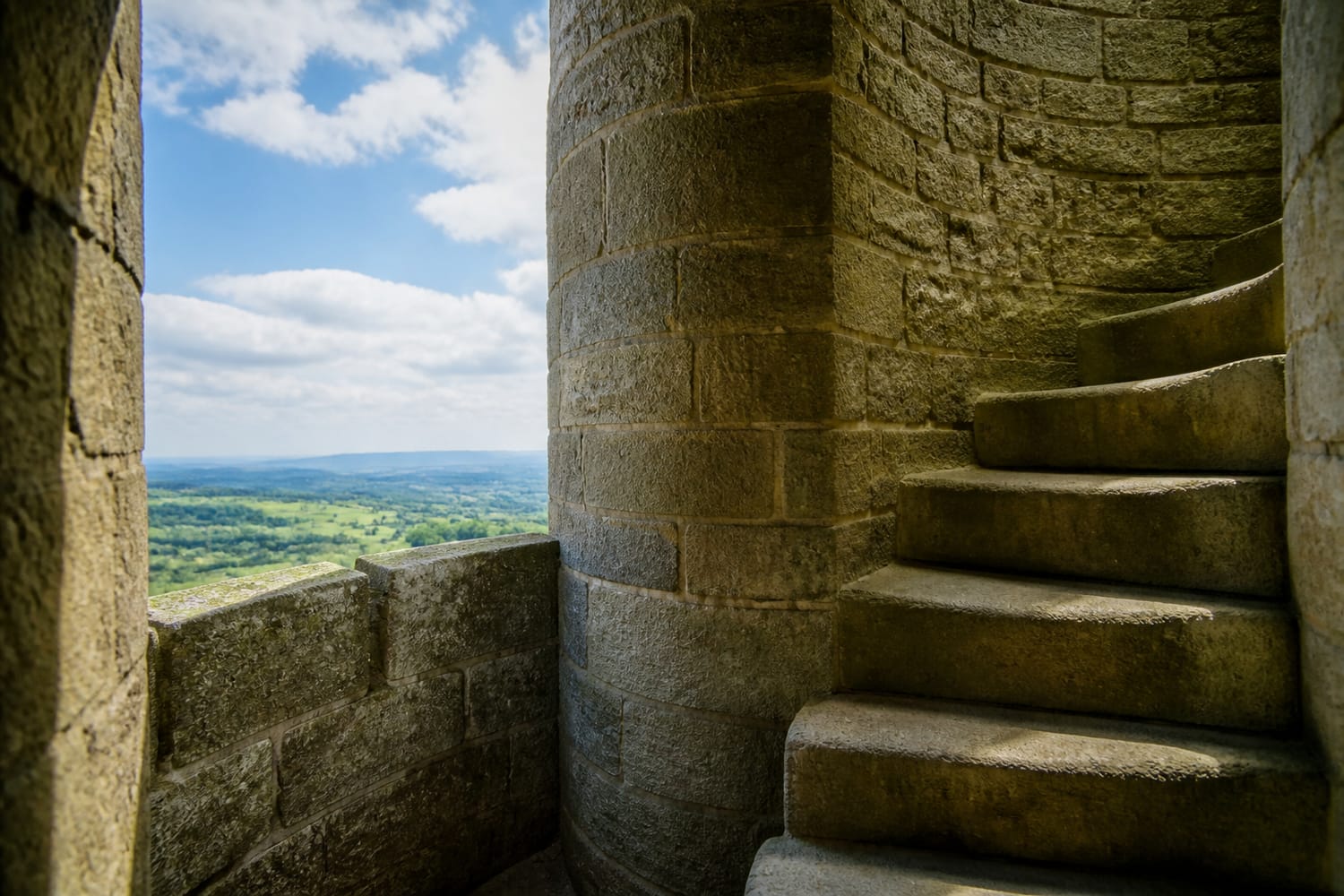
If clockwise stairs were essential to castle defense, counterclockwise ones should be rare exceptions. They aren’t. In his study of anticlockwise castle stairs, researcher Neil Guy documented more than 85 examples in medieval castles in England and Wales, dating from the late 11th century through the 1500s. His findings challenge the idea that builders consistently chose a direction to favor a defender’s sword arm.
Some examples are especially hard to dismiss. Guy identifies counterclockwise stairs in both the White Tower at the Tower of London and Norwich Castle’s great tower. At Norwich, the two completed corner staircases rose counterclockwise. These were substantial buildings, not obscure oddities whose staircases can be waved away as mistakes.
Scotland offers a particularly memorable example. At Urquhart Castle, the stair in the Grant Tower turns in different directions at different levels. Historic Environment Scotland explains the feature as a possible clue to separate building phases, and describes the blanket claim about clockwise stairs and defense as a commonly repeated myth.
None of this proves that no builder ever considered defense when planning a stair. It does show that the direction alone cannot tell us why a particular staircase was built.
What Else Were Spiral Stairs For?
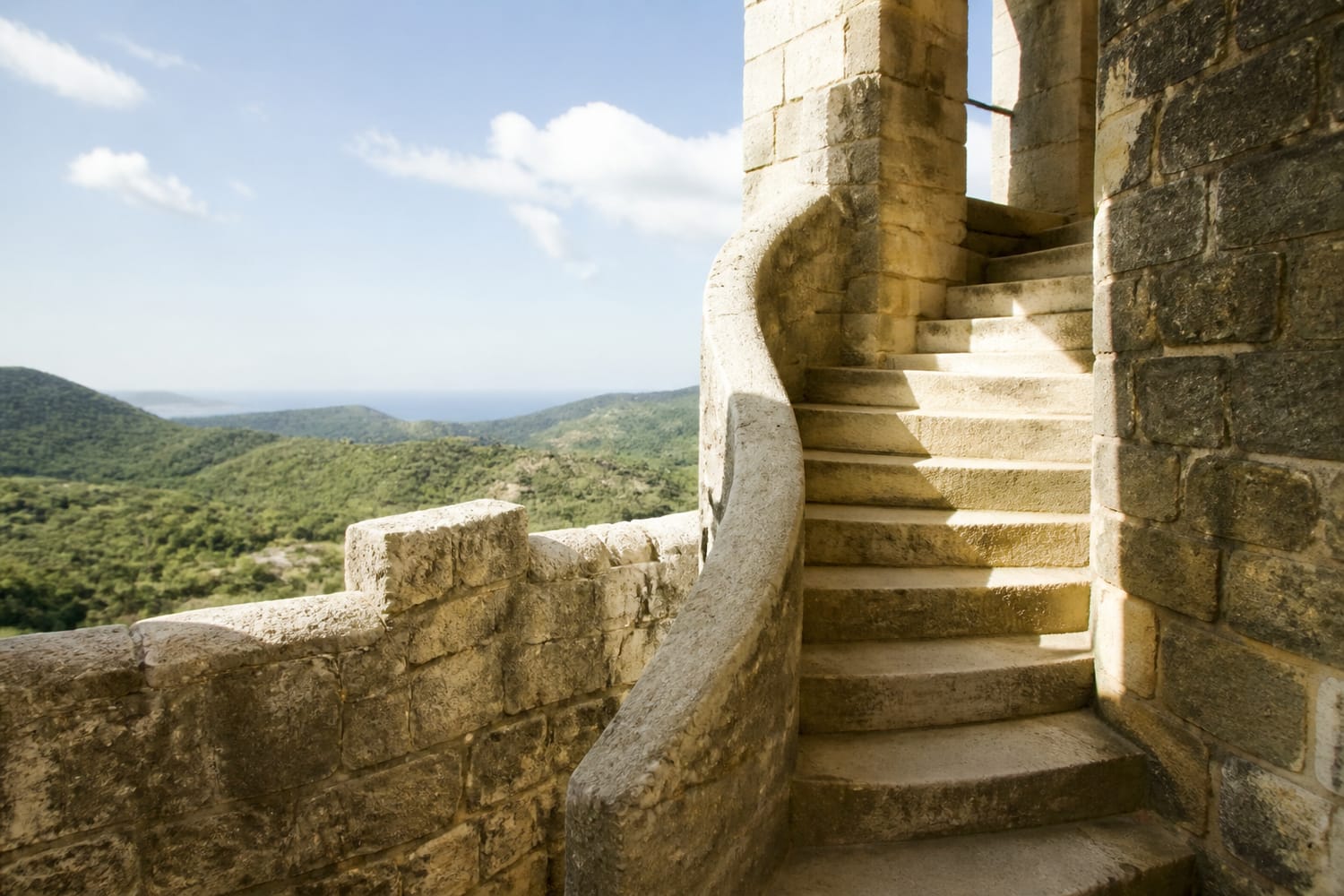
The simplest answer is also the most useful: stairs connected floors. A castle needed routes between halls, private chambers, service spaces, gatehouse rooms, and roofs. A winding staircase could fit that movement into a relatively compact area, often within a turret or the thickness of a substantial wall. Guy also notes that some grander stairs helped create an impressive approach to elite rooms.
That matters because castles were more than fortifications. They could be places to live, receive visitors, display wealth, and project authority. The imposing structures in Tour Trivia’s collection of overlooked castles around the world have histories that extend well beyond battlefield tactics. It makes sense to ask how people moved through a building on an ordinary day, not just during a siege.
Layout could matter, too. A stair’s position affected which rooms it served and where people entered or exited. In some gatehouses, paired stairs turned in opposite directions; Guy suggests they may have helped people circulate without trying to pass one another on a narrow flight. That is a proposed explanation, not a proven instruction from a medieval architect, but it takes the building’s everyday use seriously.
Appearance was another consideration. A carefully made stair could be an architectural feature, not merely a route hidden behind stonework. Once we allow for access, available space, circulation, and status, a single universal explanation looks much less convincing.
Could a Spiral Stair Still Help Defenders?
Yes—in a limited sense. A narrow passage would restrict how many people could move through it at once, and someone climbing toward an opponent above would face an uncomfortable fight. A door at the top or bottom could also make that route easier to control. Those are possible defensive effects of a staircase.
The leap comes when someone claims that its clockwise direction proves deliberate design for right-handed swordplay. The surviving counterclockwise examples contradict that as a universal rule. Even with a clockwise stair, the shape of the space does not automatically give the defender a free swing; both people must contend with walls and steps.
The fairest verdict is therefore not “stairs had nothing to do with defense.” It is that the popular story assigns one neat purpose to buildings shaped by several needs.
How to Read a Staircase on Your Next Castle Visit
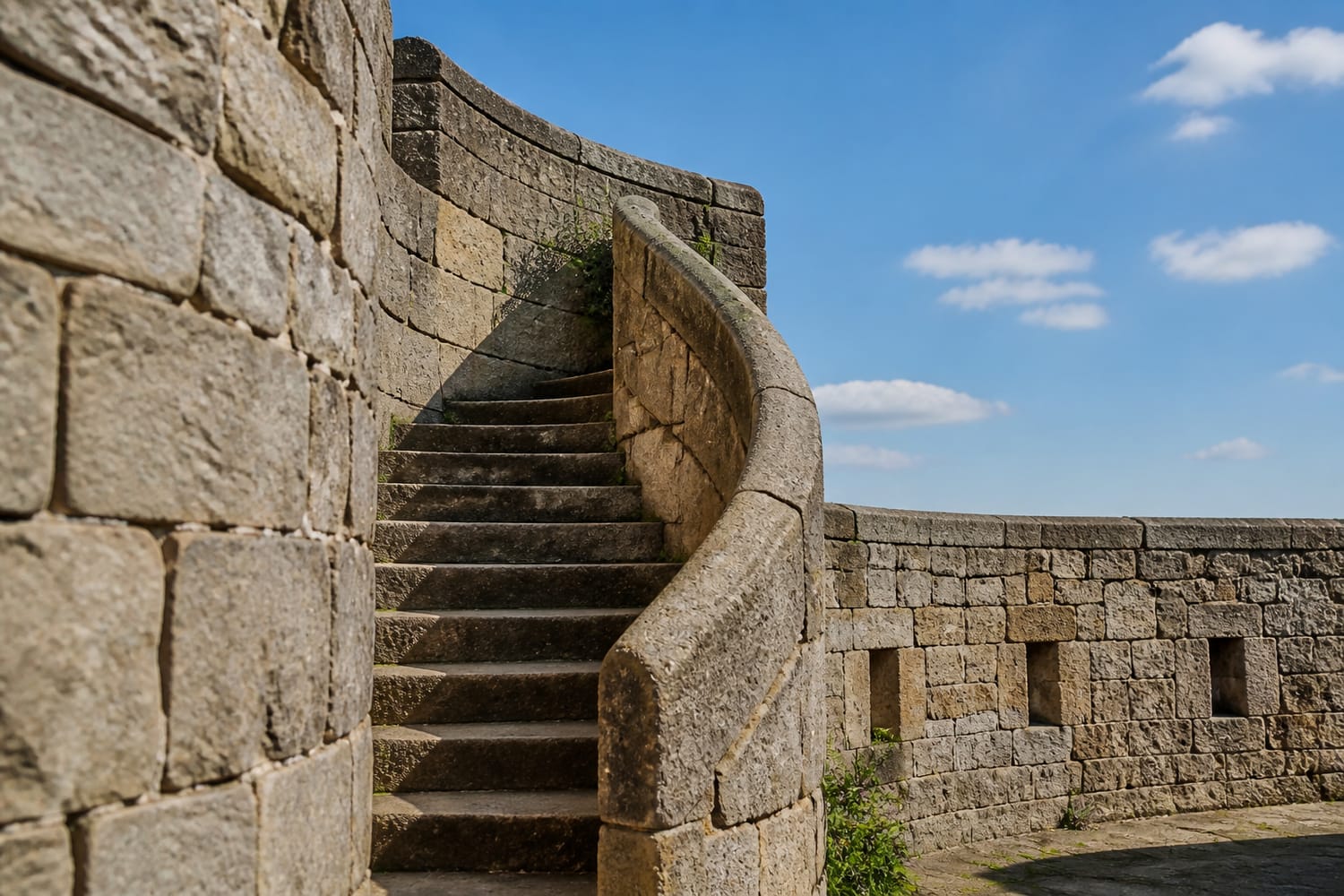
When you encounter a spiral stair, first ask which way it rises, rather than which way it looks from the top. Then look for its entrances: does it link important rooms, a gatehouse, or a roof? Is there another stair nearby? Those details can tell you more about the building’s layout than the sword-arm story alone.
Notice the stair’s scale as well. Is it a tight climb or a broad, carefully finished approach? Guy’s research describes castle stairs that vary considerably in spaciousness and presentation. A stair built to make an arrival feel impressive invites a different question from one tucked into a small corner turret.
Finally, be cautious with extra-perfect explanations. If a guide says an uneven step was deliberately made to trip attackers, ask what evidence establishes that intention. Centuries of use and alteration can complicate what we see today; an intriguing story is a starting point for curiosity, not proof. Newcastle Castle raises the same caution about attributing uneven steps to a planned defensive trick.
The Better Castle Trivia Answer
So, were castle spiral staircases a defense feature or a popular myth? The universal clockwise-sword-defense claim is the myth. Spiral stairs could make movement through a castle controllable, and fighting on them would hardly be easy. But real castles contain stairs turning both ways, built to serve buildings that were homes and symbols of power as well as places of protection.
The next time someone points to a winding stair and announces that its secret has been solved, take another look. The most revealing question may not be “Where would a swordsman stand?” but “Where did this stair take everyone else?”