
An Island Too Sacred to Disturb
Itsukushima, commonly called Miyajima, lies in the Seto Inland Sea near Hiroshima. Long before its waterfront shrine became famous, the island and its mountainous landscape were objects of religious veneration. The sacred place was not simply a building: it was the island itself.
That distinction explains the unusual location. Hiroshima’s official guide to Itsukushima Shrine presents the traditional explanation: construction where the tides rise and fall allowed worshippers to honor the island without damaging its sacred “body.” The shoreline offered a meeting place between human worship and divine nature.
It is best understood as a religious explanation rather than a surviving construction brief. Itsukushima’s history includes legends, documented events, and later interpretations; no single explanation captures every influence behind the complex.
That makes it a fascinating companion to other landmarks built for unexpected reasons: the feature that catches our eye is not necessarily the reason a place first mattered.
A Founding Legend and Three Sea-Protecting Deities
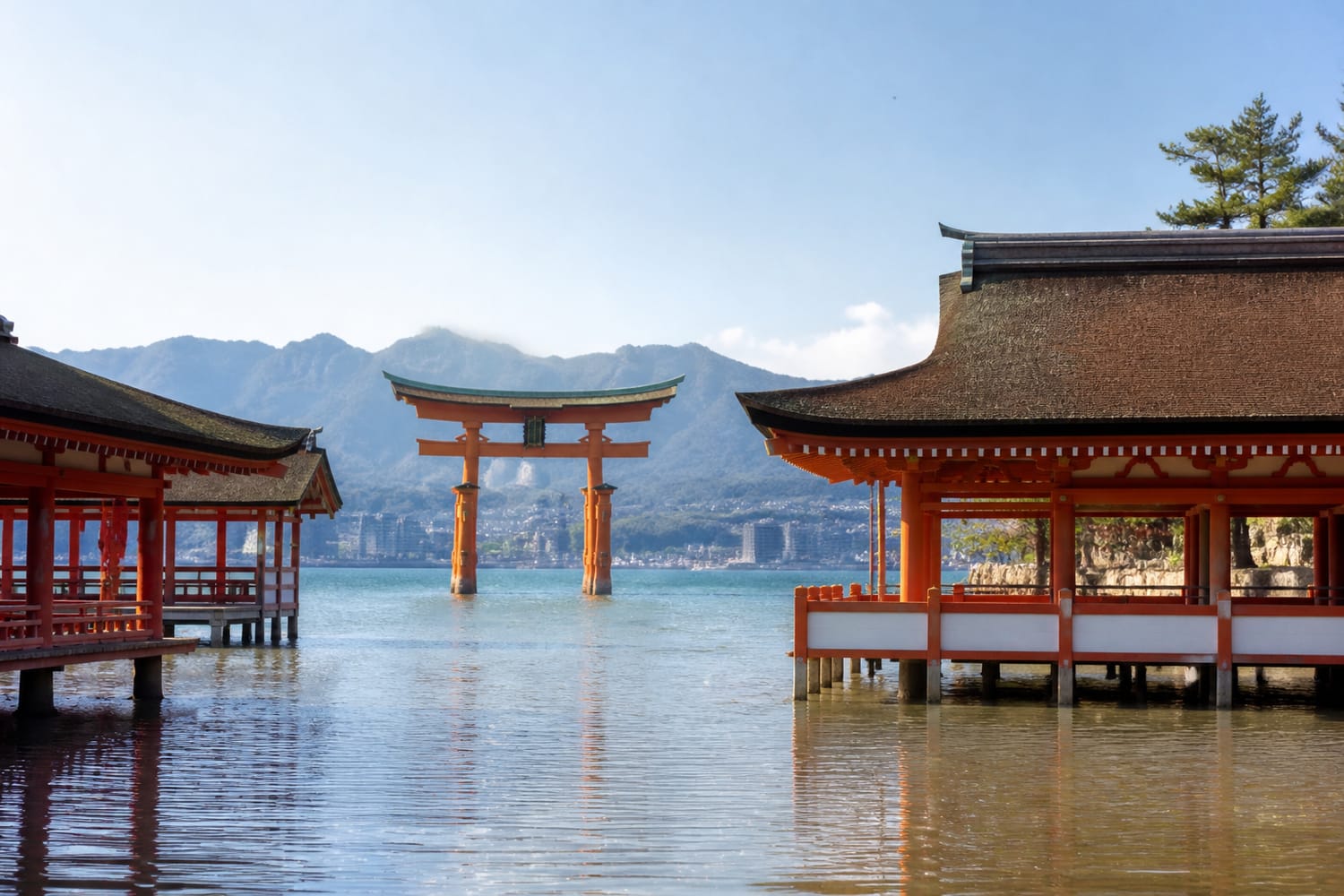
The shrine traditionally dates its foundation to 593. Its own history tells of Saeki no Kuramoto, a local ruler who received an oracle while the shrine’s three deities were seeking a place to settle. Guided by a divine crow, he sailed around the island and chose the tidal location.
Those deities—Ichikishimahime-no-mikoto, Tagorihime-no-mikoto, and Tagitsuhime-no-mikoto—have long been worshipped as protectors of seafarers, among other roles. A sanctuary facing the sea therefore had religious significance beyond its respect for the island.
There is an important historical distinction here: 593 is the traditional foundation date, while the shrine’s existence is securely documented by 811. The familiar waterfront complex took shape much later. Separating those dates avoids imagining that everything visible today has stood unchanged since the sixth century.
Taira no Kiyomori’s Palace on the Sea
The decisive transformation came in 1168, when the powerful warrior-statesman Taira no Kiyomori rebuilt the shrine on a magnificent scale. He adopted shinden-zukuri, an architectural style associated with aristocratic residences of the Heian period.
Instead of an isolated sanctuary, the resulting arrangement brought together halls, platforms, and covered corridors in a coordinated waterfront setting. Its palace-like character carried the culture of the imperial capital into a maritime landscape. Kiyomori’s patronage also helped attract aristocrats and members of the imperial family.
Other interpretations add another layer. The Miyajima Tourist Association discusses possible inspiration from the mythical Dragon Palace and Buddhist Pure Land imagery. These are theories rather than proven motives, but they show why reducing the design to a clever optical illusion misses its spiritual richness.
What Actually Makes the Shrine “Float”?
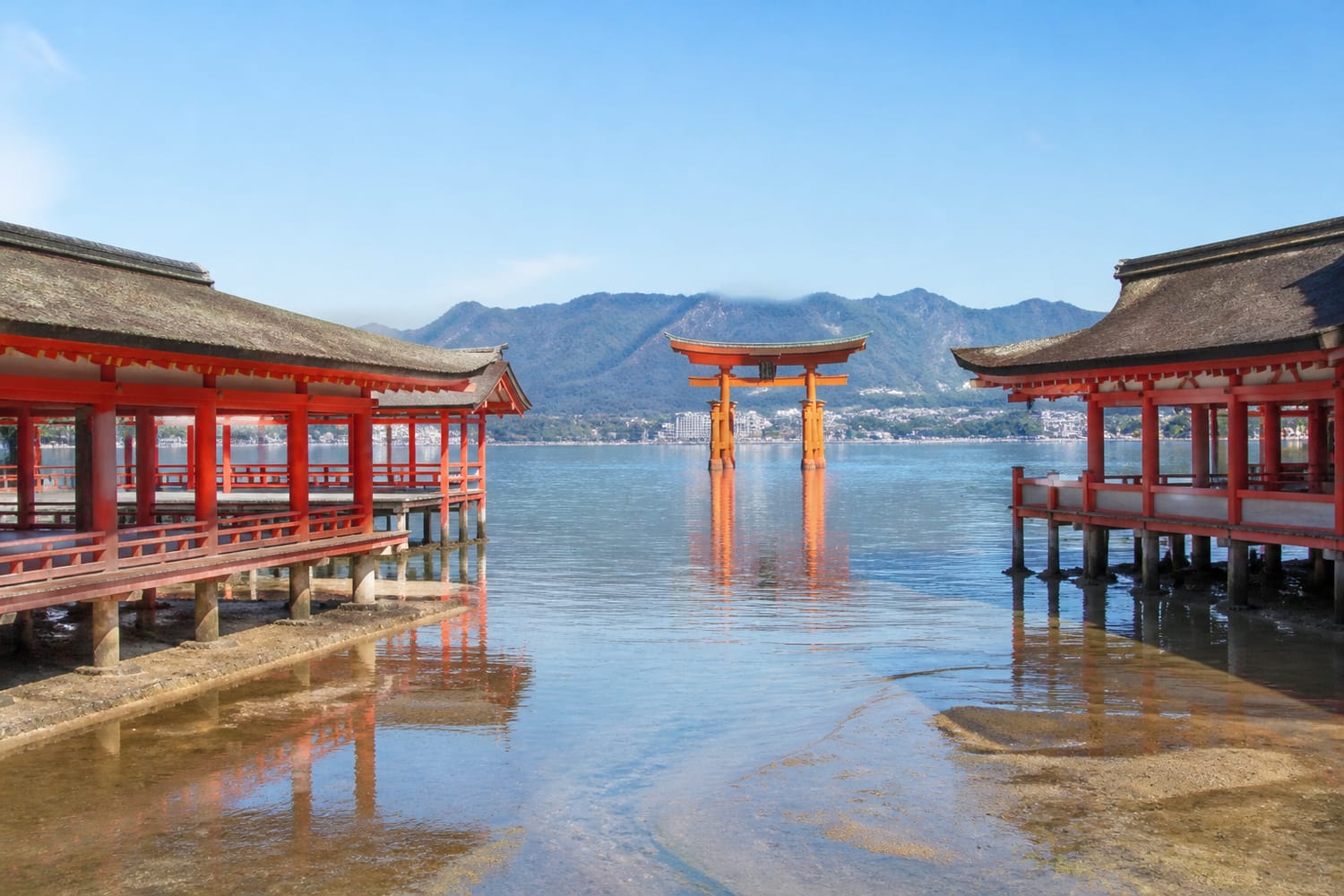
Despite the nickname, Itsukushima Shrine does not float. Its buildings stand on supports over the intertidal shore. At high tide, water conceals the ground beneath them, making the vermilion corridors and halls appear to hover above the sea. At low tide, the exposed seabed reveals the illusion.
The changing water is therefore part of the architecture’s effect, not merely its backdrop. The same buildings can look weightless at one hour and firmly grounded several hours later.
Living with that setting requires practical ingenuity. Small gaps between the corridor floorboards help relieve pressure from seawater during high tides. The shrine’s official visitor guidance even warns that narrow heels can catch in these spaces—a surprisingly everyday consequence of extraordinary architecture.
Saltwater exposure, weather, and typhoons also demand continuing maintenance. The shrine’s survival is a story of repeated care and repair, not wood somehow escaping the effects of the sea.
The Famous Gate Is Only the Entrance
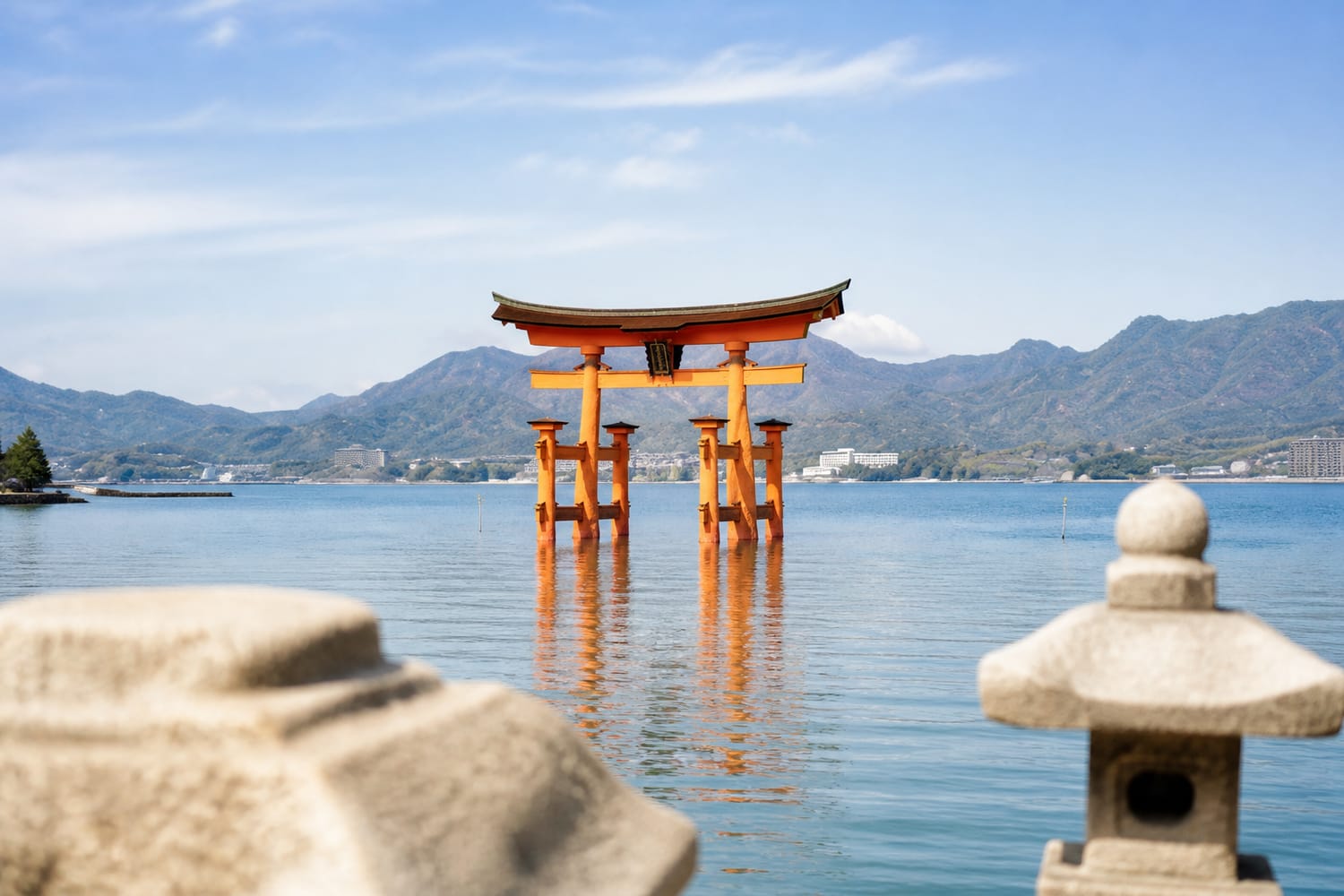
The enormous offshore gate, or O-torii, often steals attention from the shrine behind it. Historically, it marked the seaward entrance to the sanctuary. Its position makes more sense when the complex is imagined from an approaching boat rather than only from today’s walking routes.
The current gate dates to 1875 and stands approximately 16.8 meters high. According to the Miyajima Tourist Association’s O-torii guide, its enormous structure is supported by its own weight. Like the shrine, it appears to float when the tide covers its base.
Gate and shrine should not be confused: one is the monumental entrance, while the other is the larger religious complex. Looking beyond the famous silhouette reveals the relationship between the approach, worship halls, and island landscape.
It is exactly the kind of detail that rewards exploring the meaning behind familiar landmark features.
Seeing Both Sides of the Floating Landmark
For a visit that explains the design as well as showcasing it, try to experience both tidal conditions:
- At high tide, look for the floating effect around the gate and waterfront buildings.
- At sufficiently low tide, the exposed shore can allow a closer approach to the gate.
- Inside the shrine, notice the corridors and floorboard gaps rather than treating the gate as the entire attraction.
Check local tide predictions for your intended date rather than assuming that morning or afternoon guarantees either view.
Above all, look at the whole setting. UNESCO’s description of Itsukushima emphasizes the unity of shrine, sea, and mountains. That relationship supplies the most satisfying answer to the original question: the shrine was built over water not simply to look extraordinary, but to express reverence for an extraordinary sacred landscape.