
A Shoreline Isn’t Always Golden
Most of us picture a beach as a ribbon of pale, golden sand meeting blue water. But around the world, shorelines appear in far more surprising shades: jet black, cotton-candy pink, olive green, rusty red, and even dazzling white. These colors aren’t painted on by sunlight or caused by some tourist-friendly trick of the eye. They come from the minerals, shells, rocks, and tiny organisms that make up the sand itself.
Sand is really a collection of small particles, usually created when larger materials are broken down over time. Waves, wind, rivers, glaciers, and chemical weathering all help grind rocks, shells, corals, and minerals into grains small enough to fit between your toes. Because different places have different geology and marine life, they also have different “ingredients” for sand. That is why one beach may look like powdered sugar while another resembles crushed charcoal.
For travelers, colorful beaches are spectacular photo stops. For scientists, they are clues. Each grain tells a story about volcanoes, coral reefs, ocean currents, erosion, and the long journey from rock to shoreline.
What Sand Is Made Of
Sand is defined more by size than by material. Geologists typically classify sand as particles between about 0.0625 and 2 millimeters in diameter. Those particles can be made of many things, but the most common beach sand is rich in quartz.
Quartz is abundant in Earth’s continental crust and highly resistant to weathering. When rocks break down, weaker minerals often dissolve or crumble away, while quartz survives the journey. This is why many beaches have tan, cream, or light brown sand: they are dominated by quartz grains mixed with feldspar, shell fragments, and other minerals.
But not all beaches are fed by quartz-rich rocks. Some are shaped by volcanoes, coral reefs, or unusual mineral deposits. In those places, sand can take on dramatic colors. The shade depends on what materials are available nearby, how dense those grains are, and how waves and currents sort them along the coast.
Think of a beach as a natural sorting tray. Ocean energy washes lighter grains away, leaves heavier grains behind, and constantly mixes new material into the shoreline. Over centuries, this process can create beaches that look almost unreal.
Why Some Beaches Are Black
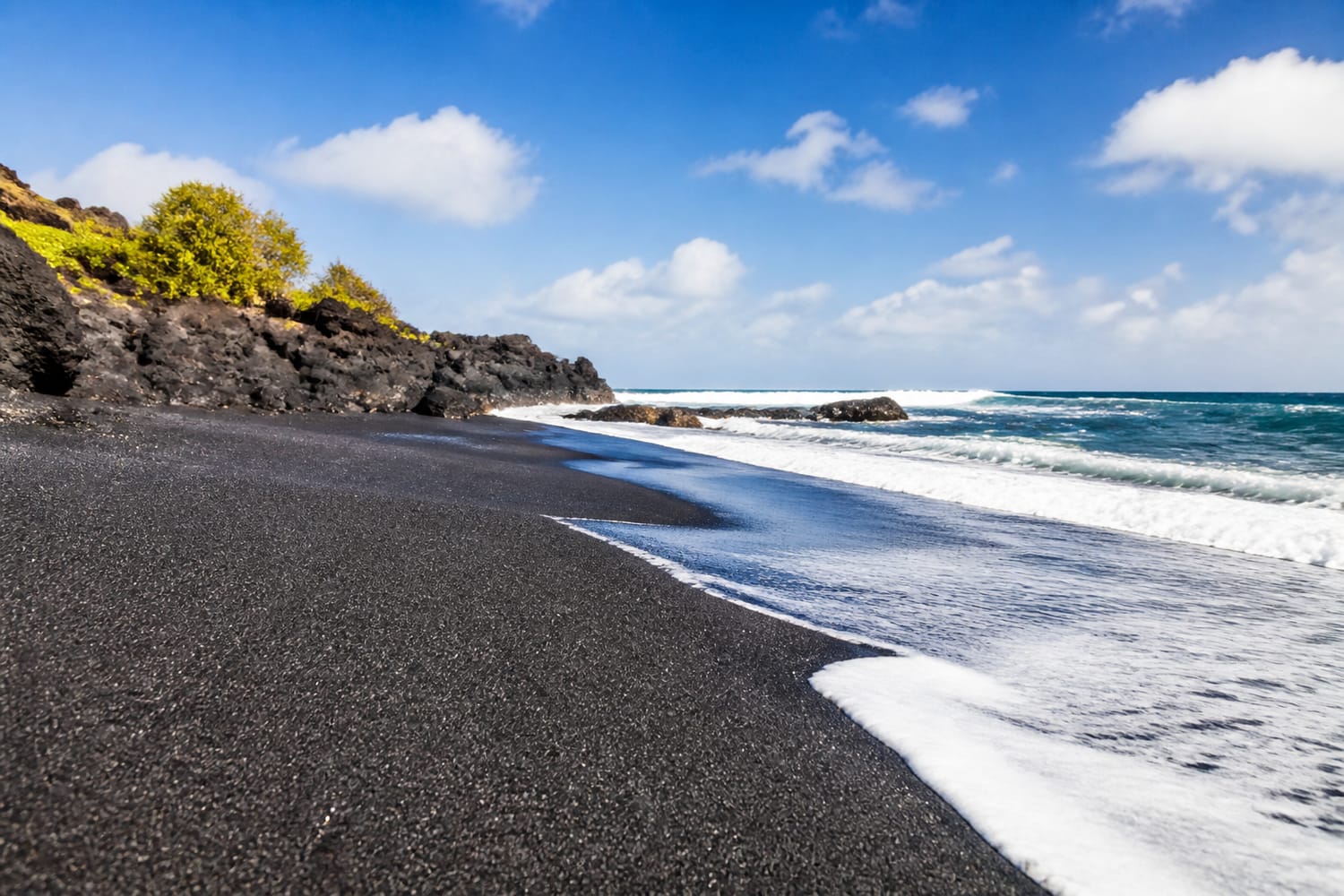
Black sand beaches are most often linked to volcanic activity. When lava flows into the ocean or volcanic rock is shattered by waves, it can break down into dark grains of basalt. Basalt is rich in minerals such as pyroxene and magnetite, which give the sand its deep gray or black color.
These beaches are common in volcanic island chains, including Hawaii, Iceland, the Canary Islands, and parts of New Zealand. In some places, black sand forms quickly after fresh lava reaches the sea. The sudden temperature change causes the lava to crack, explode, and fragment into glassy particles. Waves then tumble and smooth those fragments into sand.
Black sand can also contain heavy minerals like magnetite, an iron-rich mineral with magnetic properties. If you drag a strong magnet through certain black sands, tiny grains may cling to it. This is a fun science trick, but it also highlights why some black sand beaches feel different underfoot. Their grains can be denser than typical quartz sand.
Because dark colors absorb more sunlight, black sand beaches may become extremely hot during the day. Walking barefoot across them can feel very different from strolling across pale sand. Their striking beauty often comes with a practical warning: bring sandals.
The Secret Behind Pink Sand
Pink sand beaches get their delicate blush from a mix of white sand and reddish or pinkish particles. In many famous cases, those rosy grains come from tiny marine organisms called foraminifera.
Foraminifera are single-celled creatures that live in the ocean, often on reefs or seafloors. Some species produce shells, or tests, made of calcium carbonate. When they die, their shells can break apart and wash ashore. Certain species have red or pink shells, and when enough of these fragments mix with pale coral and shell sand, the beach takes on a soft pink color.
This process is famously seen in places like Bermuda and Harbour Island in the Bahamas. The pink hue may appear subtle in bright midday sun and more vivid during sunrise or sunset. It can also vary depending on moisture, wave action, and how freshly the sand has been replenished by offshore sources.
Pink sand may look romantic and delicate, but it is the result of an active marine ecosystem. Healthy reefs, thriving microscopic life, and steady wave transport all help maintain the color. If the offshore environment changes, the beach’s supply of pink particles can change too.
How Green Sand Forms
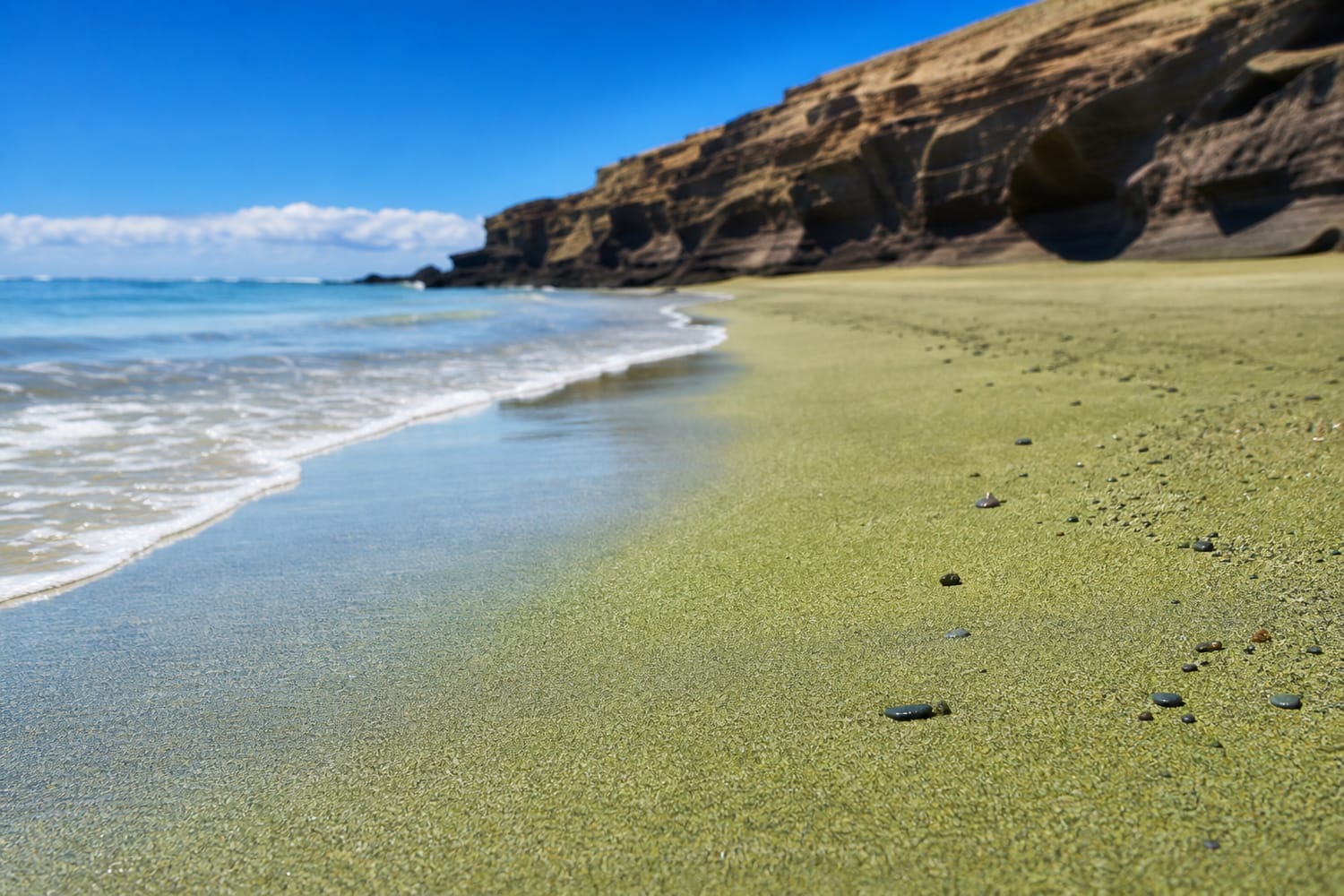
Green sand is rarer than black or pink sand, and it usually comes from a mineral called olivine. Olivine is a green, glassy mineral found in certain volcanic rocks, especially basalt. It forms deep within Earth’s mantle and can be brought to the surface by volcanic eruptions.
One of the best-known green sand beaches is Papakōlea Beach on Hawaii’s Big Island. Its sand contains abundant olivine crystals eroded from a nearby volcanic cone. As the cone weathers, olivine grains are released and carried to the shore.
Olivine is relatively dense, so waves can separate it from lighter materials. While less dense grains may be swept away, heavier olivine tends to remain concentrated on the beach. This natural sorting is part of what allows green sand to collect in noticeable amounts.
The color can range from olive to yellow-green depending on the mineral composition, lighting, and mixture with darker volcanic grains. Green sand beaches are often fragile and limited in supply. If visitors remove sand as a souvenir, they are taking away part of a slow-forming geological feature that may not easily replace itself.
White, Red, and Other Colorful Shores
Black, pink, and green beaches may get the most attention, but they are part of a much wider spectrum. Some beaches are brilliantly white because they are made of coral, shell fragments, or gypsum. The famous white sands of tropical islands often come from crushed coral and marine skeletons. In a few places, such as White Sands National Park in New Mexico, the “sand” is made of gypsum crystals rather than typical beach material.
Red and orange sands usually owe their color to iron oxide, the same type of compound that gives rust its reddish shade. When iron-rich minerals weather, they can stain sand grains or create red sediment. Beaches near red cliffs or iron-rich volcanic rocks may take on these warm colors.
Even ordinary tan beaches are colorful in their own way. Their shade reflects a blend of minerals: clear quartz, pale feldspar, dark volcanic grains, bits of shell, mica flakes, and organic material. Look closely at a handful of sand with a magnifying glass, and what seems like a single color often turns into a miniature mosaic.
Waves, Wind, and Natural Sorting
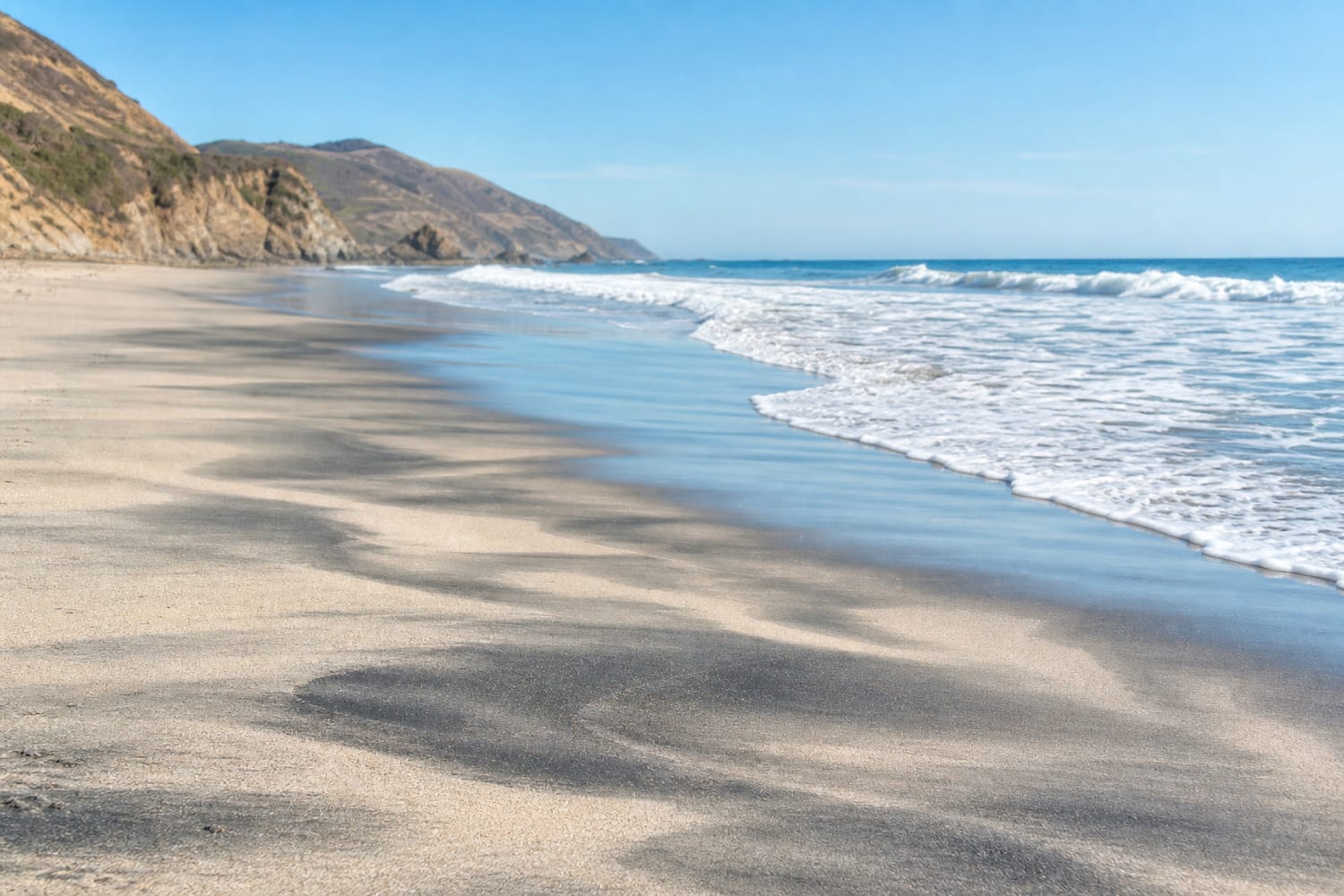
A beach’s color is not determined only by what materials exist nearby. It also depends on how those materials are transported and sorted. Rivers carry sediment from inland mountains to the coast. Waves break down cliffs and reefs. Currents move grains along shorelines. Wind can pile sand into dunes or blow finer particles away.
Grain size matters too. Coarse sand may remain near high-energy shorelines where strong waves can carry away finer particles. Fine sand may collect in calmer bays. Heavy minerals, such as magnetite or olivine, can become concentrated because they resist being washed away as easily as lighter quartz or shell fragments.
This sorting process is never finished. Beaches are dynamic landscapes. Storms can strip sand away in a single night, while calmer seasons may rebuild the shoreline. A colorful beach may appear darker after rain, brighter in dry weather, or slightly different from year to year as new material arrives.
That constant change is part of the appeal. Every beach is a moving record of local geology, climate, and ocean energy.
Why Colorful Sand Matters
Colorful beaches are more than beautiful travel destinations. They can reveal volcanic histories, reef health, erosion patterns, and sediment movement. Scientists study beach sand to understand where sediment comes from and how coastlines are changing.
For example, black sand may point to recent or ancient volcanic activity. Pink sand may indicate the presence of reef-dwelling organisms. Green sand may reveal mantle-derived minerals brought up by eruptions. Red sand can signal iron-rich geology nearby. Each color is a clue to the natural forces that shaped the region.
These beaches also remind us that coastal environments are delicate. Sand may feel limitless when you are standing on a wide shore, but many beaches depend on a specific balance of erosion, biological production, and ocean transport. Removing sand, damaging coral reefs, building too close to the shore, or altering natural sediment flow can affect that balance.
Seeing Sand With New Eyes
The next time you visit a beach, take a closer look at what is beneath your feet. A single handful of sand may contain volcanic glass, ancient crystals, coral fragments, shell pieces, and the remains of organisms too small to notice when they were alive. Its color is not random; it is a natural signature of place.
Black beaches speak of fire and lava. Pink beaches whisper of reefs and microscopic sea life. Green beaches reveal minerals born deep inside the Earth. Every shoreline has a backstory, and sand is one of the easiest ways to read it.
For curious travelers, that makes a colorful beach more than a scenic stop. It becomes a natural museum, with every grain acting as a tiny exhibit. Whether you are planning your next Tour Trivia-worthy adventure or simply daydreaming about unusual coastlines, remember: sand is not just sand. It is geology, biology, weather, and time, all ground into color.