
When Great Buildings Borrow from the Past
Some of the world’s most famous landmarks are architectural patchworks. Their builders reused columns, carvings, walls, and sculptures from older monuments, sometimes for convenience and sometimes to claim the authority of the past. Archaeologists call these repurposed elements spolia, from a Latin word associated with spoils.
Recycling stone made practical sense. Finished columns and carved marble were expensive, while abandoned temples and public buildings offered ready-made materials. Yet reuse could also carry a political or religious message. A fragment placed in a new monument might celebrate an admired civilization, demonstrate conquest, or transform an old sacred space.
These ten landmarks reveal how history can survive in plain sight—even when its pieces have been rearranged.
The Arch of Constantine, Rome
Completed in 315 CE, the Arch of Constantine commemorated Emperor Constantine’s victory over Maxentius. However, many of its most impressive reliefs were already more than a century old.
Panels, roundels, and statues were taken from monuments associated with Trajan, Hadrian, and Marcus Aurelius. Portraits were recarved to resemble Constantine, allowing the new emperor to place himself visually alongside Rome’s respected rulers. The result is one of history’s clearest examples of architectural recycling as political propaganda. A closer examination of the Arch of Constantine’s spolia reveals artwork from several distinct Roman eras.
The Basilica Cistern, Istanbul
Beneath Istanbul stands a reservoir that resembles a flooded underground palace. Constructed during Emperor Justinian I’s reign in the sixth century, the Basilica Cistern is supported by 336 marble columns, many reused from earlier Roman structures.
The most memorable recycled pieces are two enormous Medusa heads serving as column bases. One lies sideways and the other upside down, possibly because builders were more concerned with achieving the correct height than preserving their original orientation. Their precise origins remain unknown.
Tour Trivia’s guide to ancient underground landmarks explores more of this atmospheric structure.
The Mosque-Cathedral of Córdoba, Spain
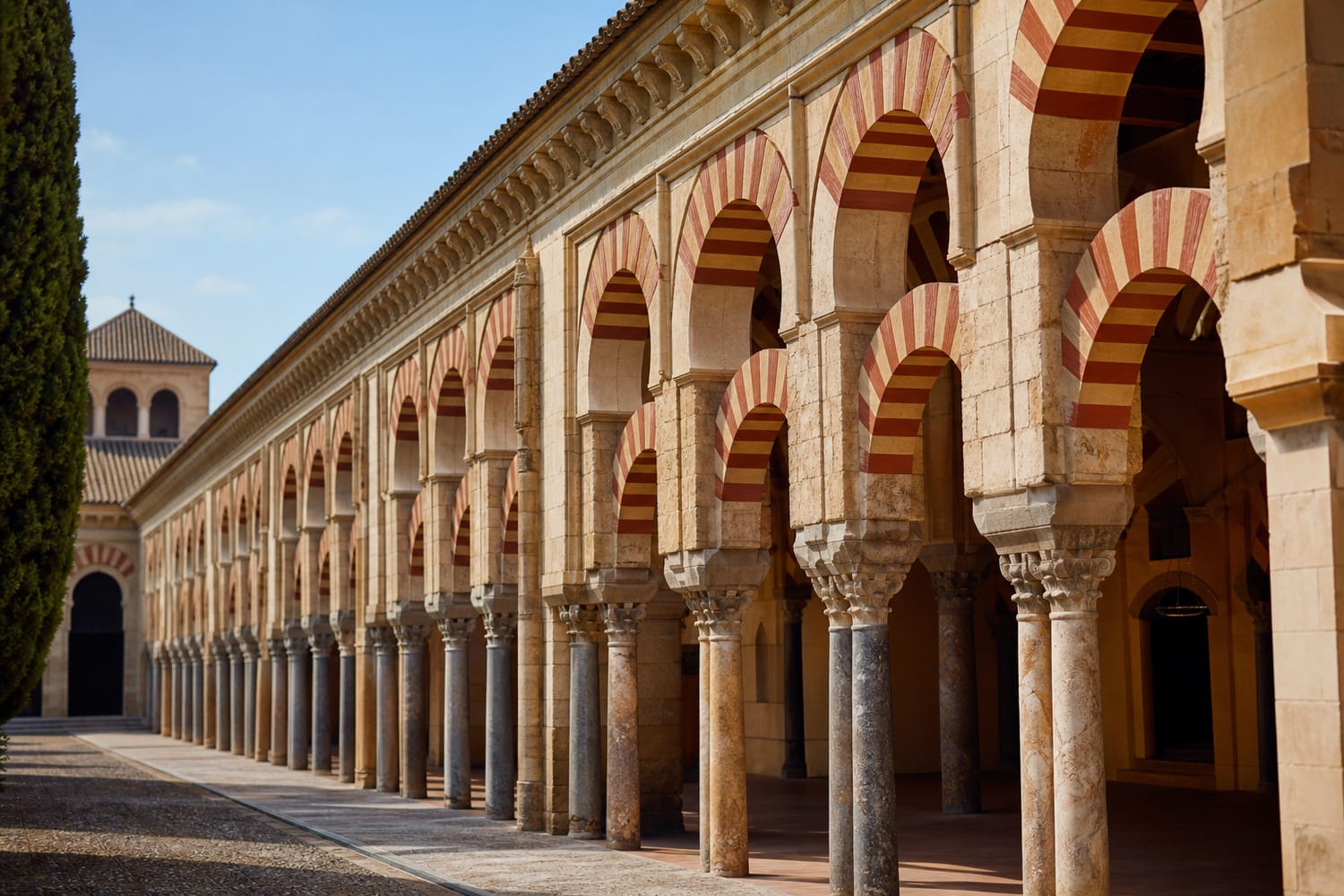
The Mosque-Cathedral of Córdoba is famous for its seemingly endless rows of striped double arches. Beneath those arches is a mismatched collection of columns and capitals obtained from earlier Roman and Visigothic buildings.
Because the recycled columns varied in material, design, and height, builders had to adapt. Their solution was an ingenious two-level arcade that raised the ceiling while creating the monument’s signature appearance.
Later expansions introduced newly made columns, but the earliest section still demonstrates how limitations can inspire architectural creativity. The result is not simply a structure assembled from old fragments, but a new masterpiece shaped by them.
St. Mark’s Basilica, Venice
St. Mark’s Basilica acquired much of its dazzling character through objects brought to Venice from elsewhere. Columns, capitals, reliefs, and sculptures from ancient and Byzantine buildings were incorporated into its interior and façades, particularly after the Fourth Crusade’s capture of Constantinople in 1204.
Among the best-known additions are the porphyry sculpture of the Four Tetrarchs and the ancient bronze Horses of Saint Mark. These imported treasures advertised Venice’s wealth and connections with the eastern Mediterranean.
The basilica consequently functions as both a church and a collection of architectural trophies, with fragments of other cities embedded throughout its design.
Aachen Cathedral, Germany
Charlemagne wanted his Palatine Chapel at Aachen to express the revival of imperial power in Western Europe. To strengthen that connection with ancient Rome, antique columns were transported north and installed within the building.
The marble shafts probably came from Rome and Ravenna, once major centers of Roman and Byzantine authority. Their placement gave the new chapel an immediate sense of antiquity and prestige.
According to the UNESCO history of Aachen Cathedral, these ancient columns remain among the defining features of its remarkable interior. Charlemagne was not merely reusing valuable stone; he was presenting his empire as the successor to Rome.
The Cathedral of Syracuse, Sicily
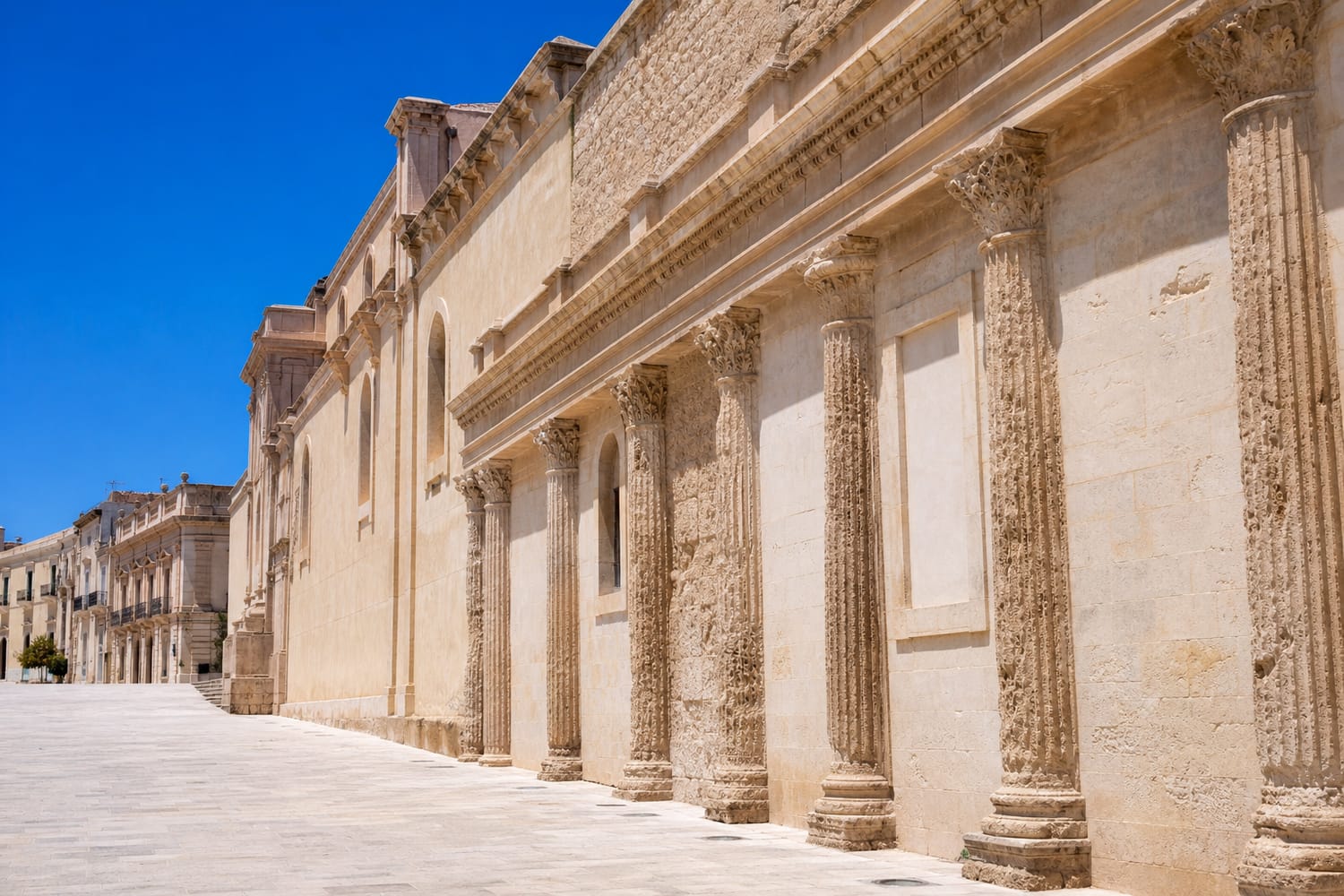
From the street, Syracuse Cathedral appears to be an elaborate Sicilian Baroque church. Walk along its side, however, and massive ancient Doric columns emerge directly from the walls.
The cathedral was constructed within the Temple of Athena, a Greek sanctuary dating from the fifth century BCE. Rather than dismantling the temple completely, early Christian builders enclosed its columns and incorporated its structure into their church.
Some columns remain visible outside, while others line the interior. Few landmarks demonstrate architectural continuity so dramatically: the ancient temple is not buried beneath the cathedral—it forms the cathedral’s physical skeleton.
The Qutb Complex, Delhi
Delhi’s Qutb complex represents the early development of Islamic architecture in northern India. Its Quwwat-ul-Islam Mosque contains carved pillars and masonry reused from earlier Hindu and Jain temples.
The contrast is striking. Floral patterns, figurative details, and temple-style carvings appear beside Islamic inscriptions and geometric decoration, creating a structure with visibly different artistic traditions.
UNESCO notes that the mosque incorporated characteristic Hindu and Jain temple elements, while its historical summary describes materials reused from around 20 Brahmanical temples. The UNESCO overview of the Qutb complex helps place this reuse within the political and architectural transformation of medieval Delhi.
The Great Mosque of Kairouan, Tunisia
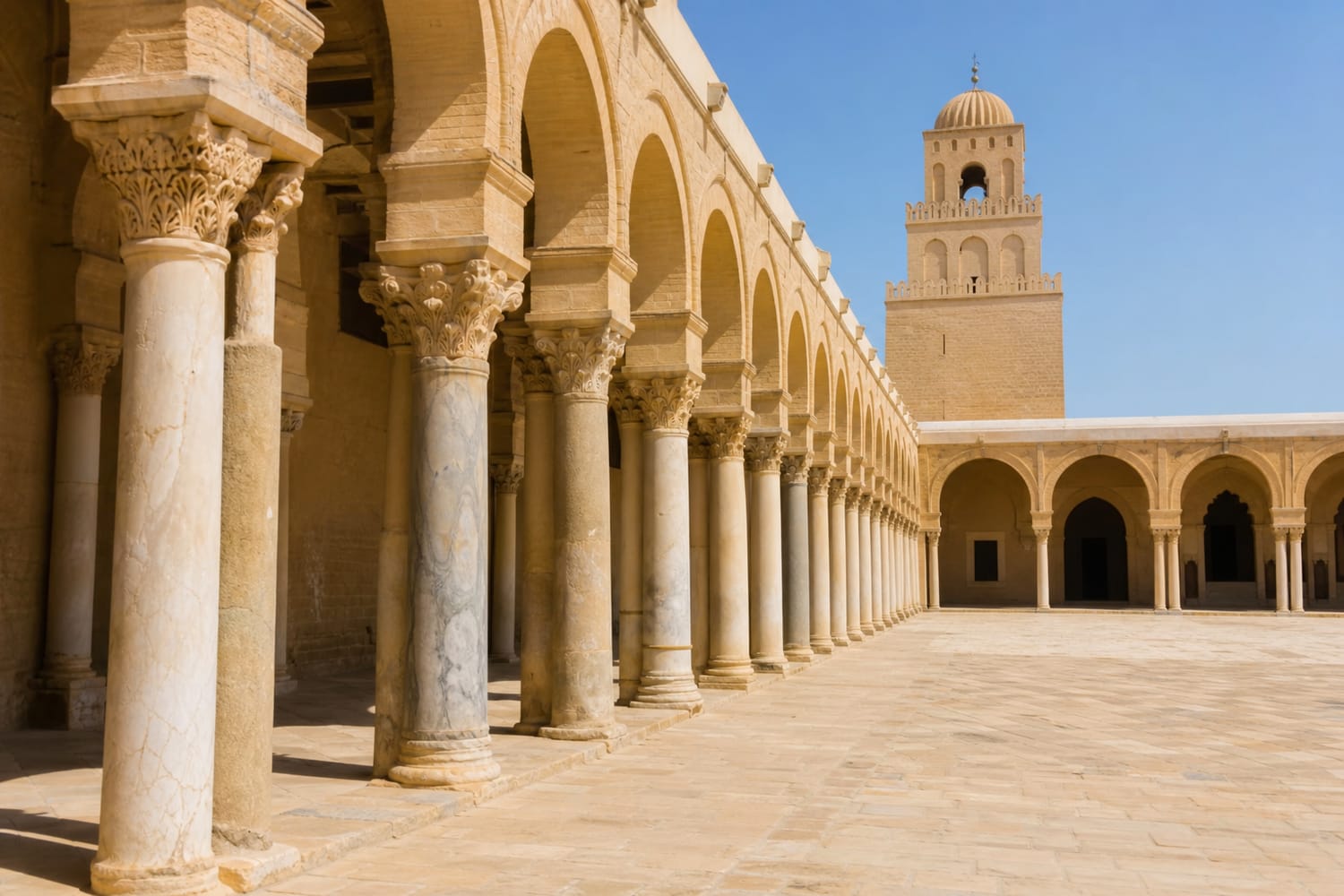
One of North Africa’s most influential Islamic monuments is supported by a forest of older columns. The Great Mosque of Kairouan incorporates Roman and Byzantine shafts and capitals gathered from ancient sites, including ruins associated with Carthage.
These recycled pieces differ in color, size, and stone. Rather than hiding the inconsistencies, builders arranged them across the prayer hall and courtyard porticoes, where their variety contributes to the mosque’s distinctive rhythm.
Today, the landmark preserves one of the most significant collections of Roman and Byzantine capitals assembled within a medieval Islamic building.
The Umayyad Mosque, Damascus
The Umayyad Mosque occupies ground that had already been sacred for centuries. An ancient sanctuary was followed by a Roman temple dedicated to Jupiter and later a Christian church associated with John the Baptist.
When the present mosque was created in the early eighth century, builders retained sections of the Roman temple enclosure and reused older materials in its walls. One incorporated beam even bears a Greek inscription connected with the earlier church.
The structure therefore preserves multiple religious and architectural eras, not merely beneath its foundations but within its visible fabric.
Santa Maria degli Angeli, Rome
Santa Maria degli Angeli e dei Martiri occupies part of the enormous Baths of Diocletian. In the 16th century, Pope Pius IV ordered the ancient bathing complex transformed into a church, with Michelangelo associated with the adaptation.
Instead of treating the Roman ruins simply as a source of loose stone, the project reused entire halls, walls, vaults, and columns. The former frigidarium became the church’s monumental interior, preserving the astonishing scale of imperial Roman engineering.
Its restrained exterior gives little warning that visitors are entering one of ancient Rome’s grandest surviving spaces.
History’s Greatest Recycling Projects
These landmarks show that famous buildings are rarely products of a single moment. They accumulate materials, meanings, and memories as cultures change around them.
Reused fragments might represent thrift, admiration, conquest, adaptation, or all four at once. Like landmarks moved piece by piece, they challenge the idea that a monument must remain untouched to be authentic. Sometimes its greatest story is written in stones that once belonged somewhere else.