
When Clocks Became Models of the Universe
Landmark astronomical clocks do far more than divide the day into hours. Through rotating dials, mechanical planets, lunar globes, calendars, and tidal indicators, they turn complex natural cycles into public theater. These ten remarkable timepieces reveal how generations have tried to capture the workings of Earth and the heavens in gears.
Prague Astronomical Clock, Czech Republic
Mounted on Prague’s Old Town Hall, the celebrated Orloj has been astonishing crowds since its astronomical dial was installed in 1410. Its moving symbols represent the Sun and Moon, while a zodiac ring and colored sections depict the sky above and below the horizon.
The clock also presents Central European, Old Bohemian, Babylonian, and sidereal time. Below the astronomical display, a calendar dial identifies the date, month, and season. Visitors usually arrive for the hourly procession of Apostles, but learning to read the intricate dial is equally rewarding. The official Prague City Tourism guide to the Orloj explains its many layers.
Travelers spending more time in the city can pair the clock with Tour Trivia’s look inside the Strahov Monastery Library and other majestic libraries.
Hampton Court Astronomical Clock, England
Installed at Hampton Court Palace in 1540, this 15-foot-wide clock was practical as well as decorative. Its copper dials display the hour, date, zodiac, lunar phase, age of the Moon, and position of the Sun.
Most unusually, it once showed the approximate time of high water at London Bridge. That information helped Tudor courtiers plan river journeys between the royal palace and London, when traveling by boat could be faster and more comfortable than using rough roads. The clock consequently connected palace life to both the sky and the Thames.
St. Mark’s Clock, Venice
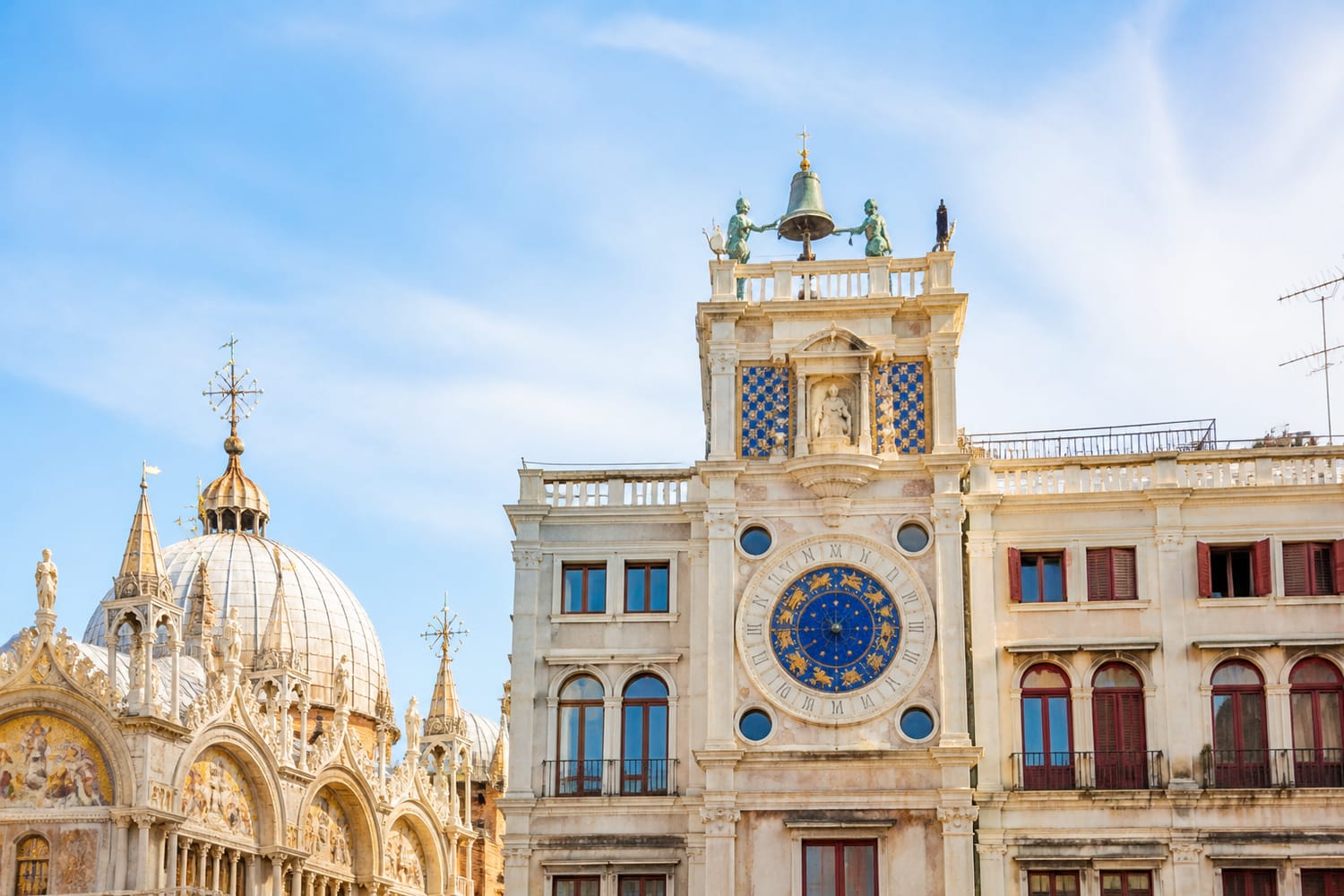
Venice’s blue-and-gold clock face looks suitably grand above the entrance to the city’s busiest square. Its outer rings carry Roman numerals, zodiac signs, constellations, months, and dates. A golden Sun serves as the hour hand, while a rotating Moon indicates its changing phases.
The display reflects Venice’s dependence on astronomy and navigation. Above it, two bronze figures known as the Moors strike the bell. Guided visits allow travelers to examine the machinery inside the tower; the official museum description of the clock face helps decode what they are seeing.
The neighboring basilica has an equally layered history, explored in Tour Trivia’s guide to landmarks built with pieces of older wonders.
Strasbourg Cathedral Astronomical Clock, France
The monumental clock inside Strasbourg Cathedral combines astronomy, religion, mathematics, and mechanical spectacle. Its present mechanism dates largely from the 19th century, although earlier astronomical clocks occupied the cathedral for centuries.
An astrolabe displays planetary movement, while a perpetual calendar accounts for leap years and calculates movable religious observances, including Easter. Automata mark the passage of time, and a celestial globe shows the stars visible above Strasbourg. It is less a conventional clock than a towering mechanical encyclopedia of the cosmos.
Zytglogge, Switzerland
Bern’s Zytglogge began as a city gate before becoming one of Switzerland’s most recognizable clock towers. Its astronomical calendar clock dates from 1530 and presents the zodiac, lunar phase, date, sunrise, and sunset.
The painted dial follows a geocentric model, placing Earth at the center while the Sun, Moon, and stars appear to travel around it. Just before each hour, bears, a jester, a rooster, and the figure of Chronos perform above the street. The mixture of serious astronomy and playful automata makes the Zytglogge an enduring symbol of Bern.
Wells Cathedral Clock, England
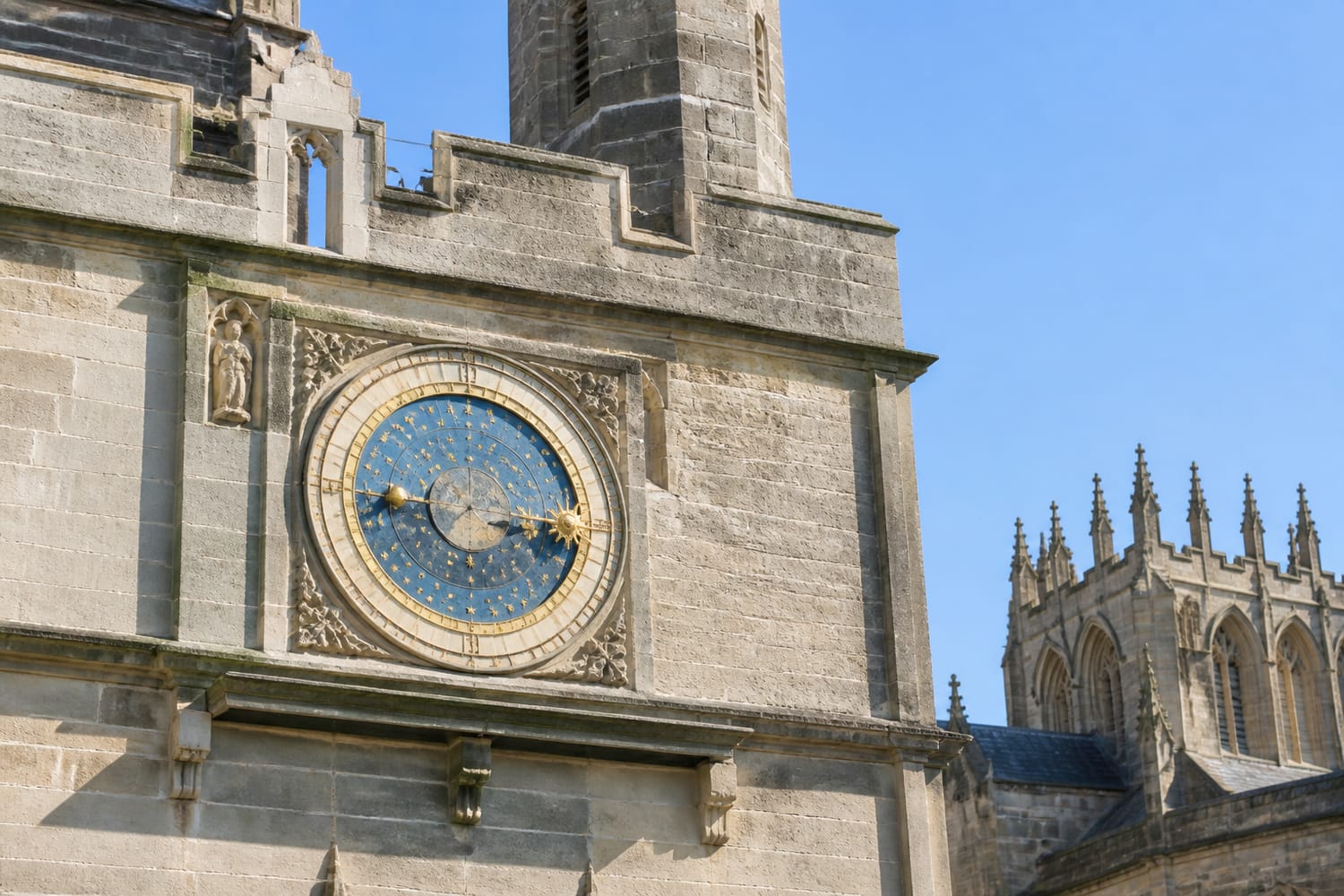
Created around 1390, the astronomical clock at Wells Cathedral preserves a medieval image of the universe. Earth occupies the center, while a golden Sun circles a 24-hour dial against a background of stars.
Its central scale records the Moon’s age during its monthly cycle. Every quarter-hour, mechanical knights charge into a miniature jousting match, with one unfortunate rider repeatedly knocked from his horse. Although the original mechanism is now displayed at London’s Science Museum, the historic cathedral face continues to combine astronomy with humor and spectacle.
Münster Cathedral Astronomical Clock, Germany
The astronomical clock in Münster Cathedral is remarkable for displaying the traditional seven “planets” of the geocentric system: the Moon, Mercury, Venus, Sun, Mars, Jupiter, and Saturn. Its planetary hands indicate their apparent locations against the zodiac.
The Moon hand also reveals lunar phases, while the Sun hand marks both the hour and the Sun’s changing seasonal height. Below, a calendar records saints’ days, months, and astronomical cycles. Unlike modern clocks, its principal hand travels counterclockwise, following the Sun’s apparent path across the sky.
Lund Cathedral Astronomical Clock, Sweden
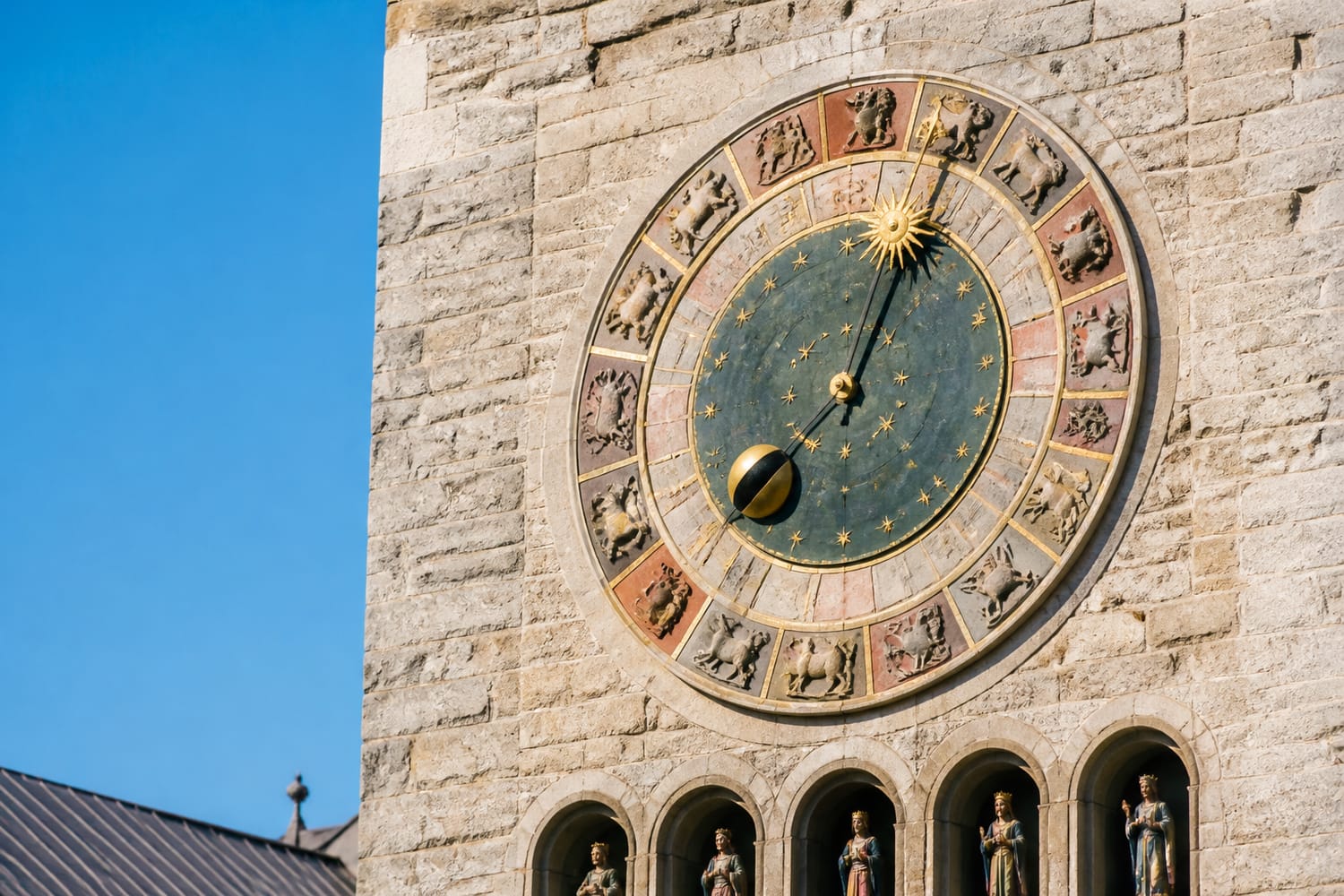
Known as the Horologium Mirabile Lundense, or “Wonderful Clock of Lund,” this cathedral clock was created around 1425. Its upper dial uses hands for the Sun, Moon, and stars to portray the heavens above Lund.
Viewers can determine lunar phases, sunrise, sunset, and the Sun’s changing annual path. Its calendar contains zodiac figures, feast days, and calculations for religious holidays. When the clock performs, mechanical figures appear while the medieval hymn “In Dulci Jubilo” plays, transforming scientific information into a miniature ceremonial show.
Jens Olsen’s World Clock, Denmark
Completed in 1955, Jens Olsen’s World Clock occupies Copenhagen City Hall and demonstrates what astronomical clockmaking could accomplish in the modern era. Its thousands of components display local and solar time, world time, calendars, stars, and planetary positions.
The clock also calculates full moons and future religious holidays. One extraordinarily slow gear tracks the gradual precession, or wobble, of Earth’s axis over thousands of years. Visitors can learn about the machinery through the Museum of Copenhagen’s World Clock exhibition.
Messina Astronomical Clock, Italy
Messina Cathedral’s bell tower contains a 20th-century astronomical clock that turns celestial motion into a monumental public performance. One dial presents the solar system, with planets traveling around the Sun against a ring of zodiac figures.
A half-gold, half-black globe rotates to display the Moon’s phases. Below it, a perpetual calendar identifies the year, month, day, and movable religious celebrations. The tower’s elaborate automata—including a roaring lion and crowing rooster—come alive daily, making astronomy part of the city’s theater.
Measuring Humanity’s Place in the Cosmos
These clocks were built in different centuries, yet each addresses the same question: how can enormous natural cycles be made understandable? Their dials transform tides, lunar months, planetary paths, and centuries-long calendars into visible motion. More than tourist attractions, they are mechanical maps of how people once interpreted—and continue to marvel at—the universe.