
Building Beyond the End of the Road
Long before helicopters and heavy-duty trucks, builders raised monuments on ocean rocks, mountain summits, and nearly inaccessible cliffs. With no conventional road to the construction site, they relied on boats, railways, ropes, sledges, and a cleverer solution: using stone already there. These landmarks transformed extreme geography from an obstacle into part of the design.
For more isolated wonders, explore the world’s most remote landmarks.
Machu Picchu, Peru
Machu Picchu stands on a narrow Andean ridge nearly 8,000 feet above sea level. Rather than hauling most of its granite up from the Urubamba Valley, Inca builders used a quarry within the site itself. Workers shaped the available rock with hammerstones, then moved blocks over short distances using human labor, ropes, levers, and prepared pathways.
The landscape supplied more than building stone. Crushed rock went into foundations and drainage layers beneath terraces and plazas, allowing the mountaintop city to withstand intense seasonal rain. Much of Machu Picchu’s greatest engineering remains hidden underground.
The Rock-Hewn Churches of Lalibela, Ethiopia
At Lalibela, builders solved the transportation problem by reversing the usual construction process. Instead of delivering blocks to the site, they cut 11 medieval churches directly from the living volcanic rock.
Workers excavated trenches around enormous sections of bedrock, then hollowed out windows, doors, columns, rooms, and passageways. The main logistical challenge was not bringing material in but carrying countless baskets of broken stone out. The result belongs among the world’s most extraordinary landmarks carved from a single piece of rock.
Petra, Jordan
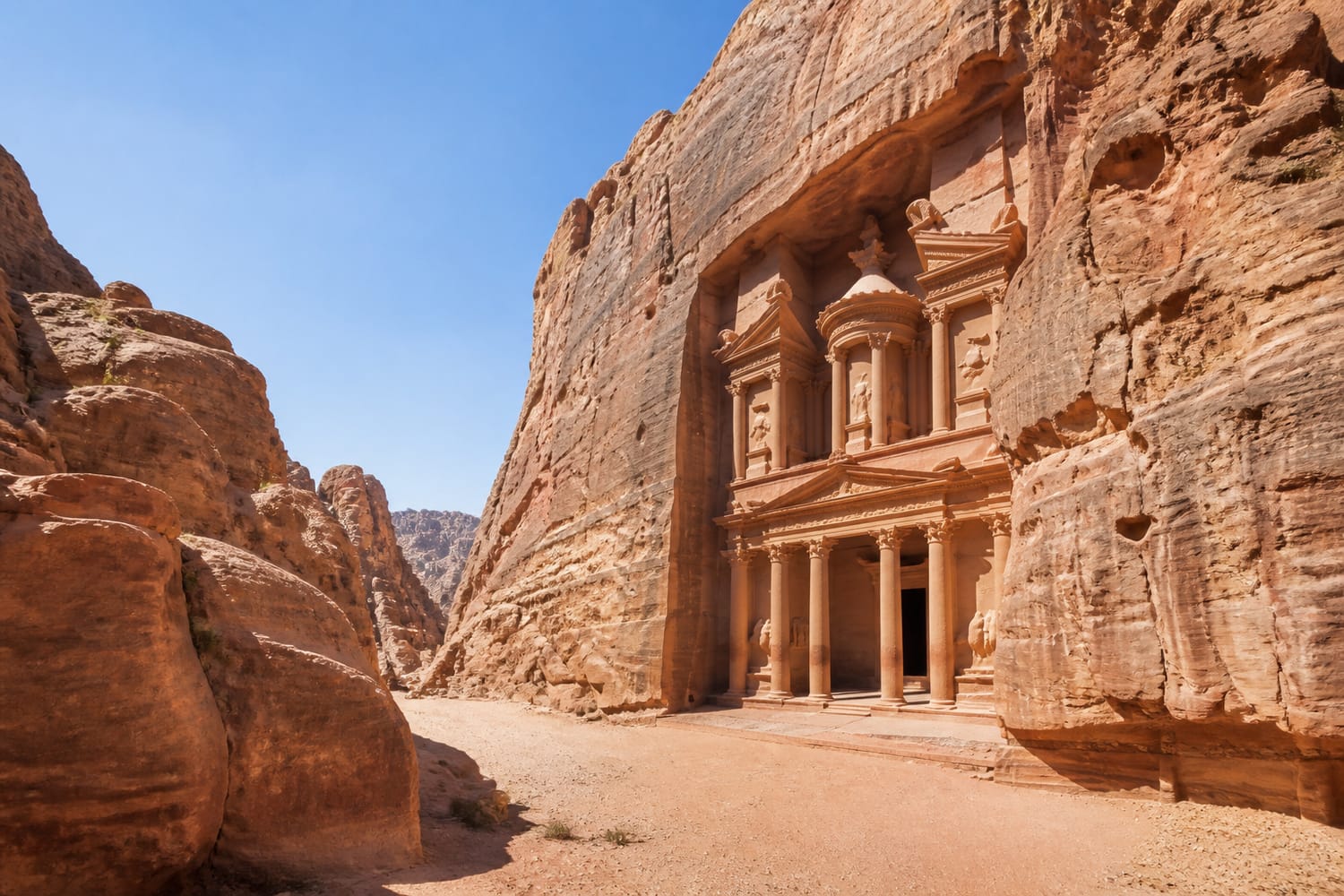
Petra’s famous Treasury appears to have been assembled like a classical temple, but its elaborate façade remains attached to the sandstone cliff. Nabataean craftspeople carved much of the city directly into the surrounding rock, dramatically reducing the amount of heavy material that needed to pass through its narrow gorges.
Freestanding walls and infrastructure still required transported supplies, but Petra’s most recognizable monuments were created largely through subtraction. The mountain was simultaneously the quarry, building site, and finished structure.
The Monasteries of Meteora, Greece
Meteora’s monasteries occupy sandstone pillars rising hundreds of feet above the plains of central Greece. When the communities were established, there were no practical roads to the summits and, in some cases, no permanent stairs.
Stone, timber, food, workers, and visitors were raised in baskets or nets operated by windlasses. Long removable ladders provided another precarious connection to the ground. According to UNESCO’s Meteora profile, the monasteries were built under seemingly impossible conditions without practicable roads.
Mont-Saint-Michel Abbey, France
Before modern access routes transformed Mont-Saint-Michel, the rocky tidal island was cut off whenever the sea covered the surrounding flats. Medieval builders nevertheless constructed an immense abbey that appears to climb toward the sky.
Much of its granite came from the Chausey Islands offshore. It had to cross the water before being moved up the mount’s steep slopes, where cranes, winches, ramps, and human labor lifted it into position. A permanent road embankment did not appear until 1879. The abbey’s story adds another dimension to Tour Trivia’s landmarks that can only be visited at low tide.
Bell Rock Lighthouse, Scotland
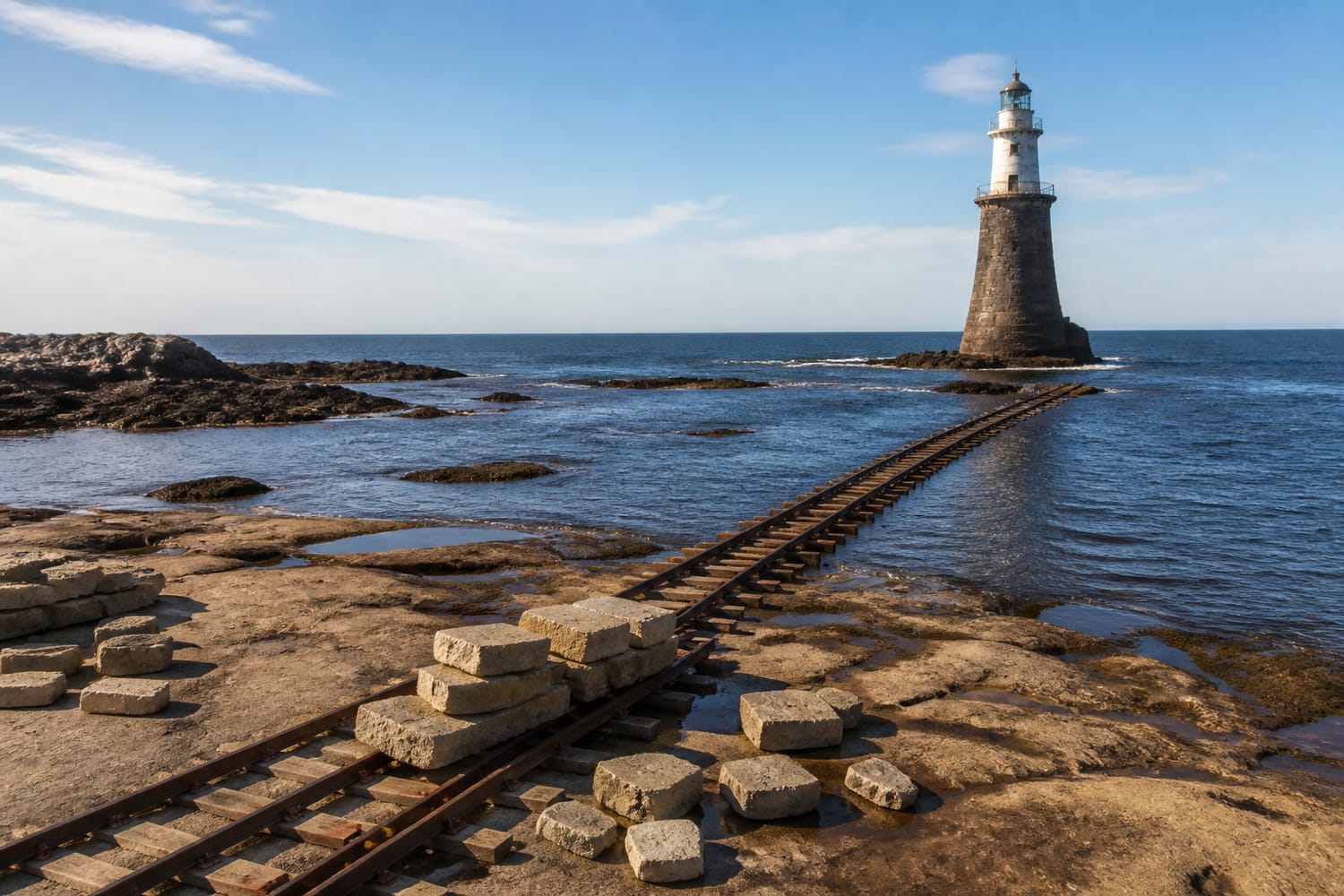
Bell Rock lies roughly 11 miles off Scotland’s coast and disappears beneath the North Sea at high tide. Builders could work directly on the reef for only brief periods when the water receded.
Granite and sandstone were shaped at an onshore yard, loaded onto ships, and transferred to shallow praam boats for the final approach. Once landed, the numbered blocks traveled along temporary iron rails to the lighthouse site. Cranes and winches then set more than 2,800 pieces of masonry into their assigned positions.
Bishop Rock Lighthouse, England
Bishop Rock is a tiny Atlantic ledge west of the Isles of Scilly. Waves regularly sweep over it, leaving no room for a road, storage yard, or permanent construction camp.
Granite was shipped from mainland Britain to an island depot, where each block was shaped and numbered. Boats carried the finished stones to the rock whenever weather permitted. As Trinity House’s account of Bishop Rock explains, blocks weighing one or two tons were dovetailed and keyed together to form a structure capable of resisting the sea.
Skellig Michael Monastery, Ireland
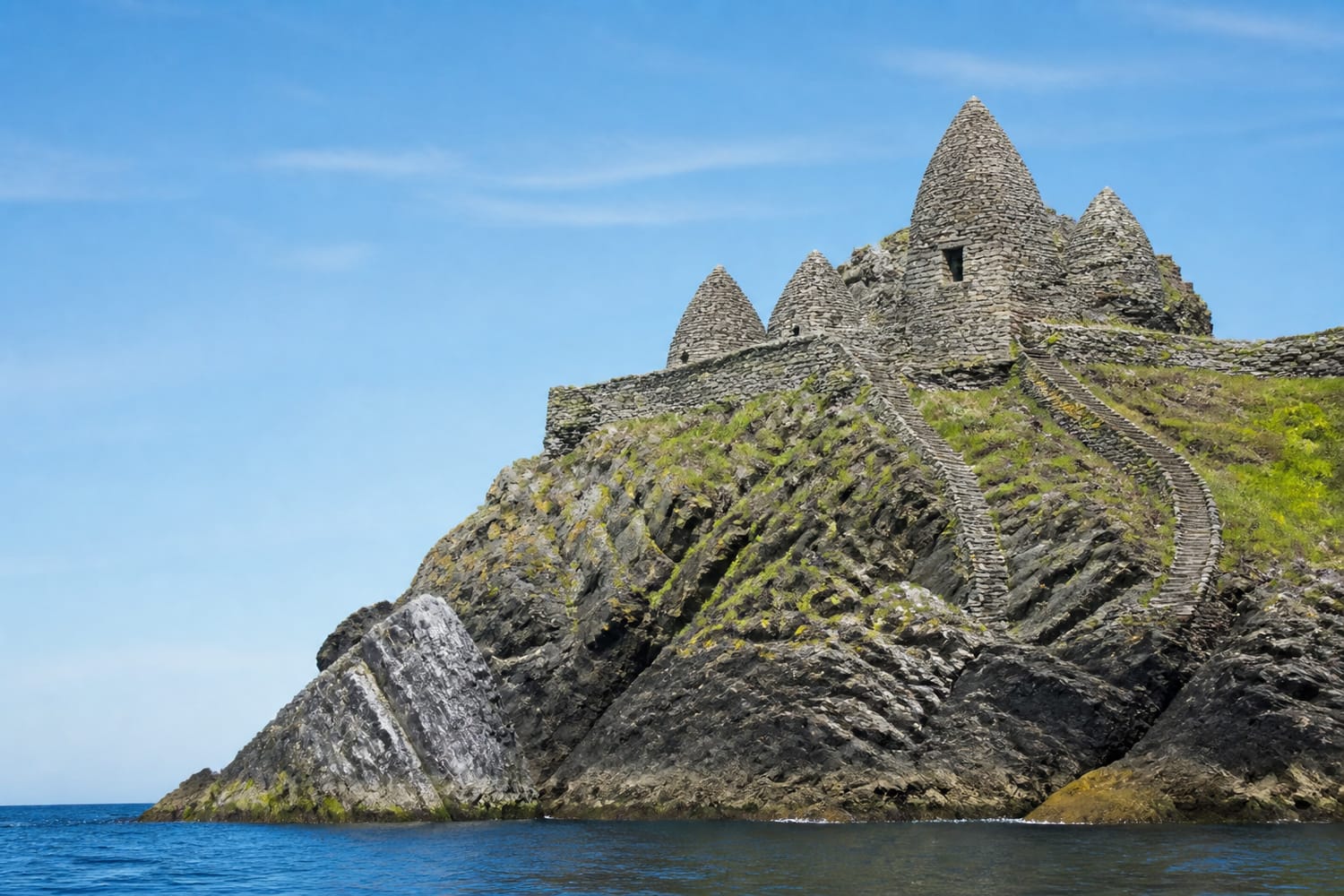
Early medieval monks built stone cells, oratories, retaining walls, and stairways on Skellig Michael, an isolated Atlantic island nearly eight miles from County Kerry. Its steep cliffs and rough landing points made every arrival uncertain.
Fortunately, the island itself supplied much of the building stone. Rock from the slopes above the monastery could be gathered and shaped locally, while dry-stone construction reduced the need for imported mortar. Boats still had to deliver people, tools, food, timber, and anything else the island could not provide.
Christ the Redeemer, Brazil
Christ the Redeemer stands atop Corcovado Mountain, high above Rio de Janeiro. The summit’s steep, forested terrain was unsuitable for ordinary construction traffic, but engineers had one important advantage: the Corcovado cog railway had opened decades earlier.
For four years, trains carried workers and the monument’s components uphill. Reinforced concrete created the statue’s structure, while small soapstone tiles formed its durable outer surface. Without the railway, delivering the enormous quantities of material required for the monument would have been far more difficult.
Jungfraujoch, Switzerland
Building the Jungfrau Railway and its high-altitude station meant advancing through the Eiger and Mönch rather than approaching by road. Work began from Kleine Scheidegg in 1896 and progressed in stages as crews blasted tunnels through the mountains.
The completed sections of track became the supply line for the next section. During the early winters, when connecting rail service stopped, huskies transported provisions to the Eiger Glacier construction colony. The official history of the Jungfrau Railway records a project powered by picks, shovels, dynamite, railcars, and determined labor.
When the Location Became the Solution
These landmarks were not built despite their surroundings; they were built by understanding them. Cliffs became quarries, oceans became supply routes, and unfinished railways became moving construction corridors.
Their builders could not simply order another truckload. Every block, tool, and meal required planning. That constraint encouraged solutions so inventive that the journey of the materials is often as remarkable as the finished landmark itself.