
A Stone Wall With No Builders
Stand beside a cliff of closely packed stone pillars, and it can look as though someone arranged them by hand. Many have straight sides and flat, polygonal ends that fit together like paving stones. Yet these columns formed without a mason: thick molten rock cooled, contracted, and cracked. The fractures divided one mass of rock into the giant “posts” we see today. Geologists call the pattern columnar jointing.
The famous examples are spectacular, but the process begins with an ordinary physical problem. As hot rock loses heat, it takes up less space. When it cannot shrink smoothly, it breaks.
From Flowing Lava to Solid Rock
Picture a thick lava flow settling into a valley. Its exposed top begins losing heat to the air, while its bottom cools against the ground. The middle stays hot longer. As the outer layers solidify and continue to cool, they contract, building stress within the rock.
Cracks release that stress. They spread across the cooling surfaces and advance into the hotter interior as cooling continues. The resulting network of fractures separates the rock into long columns; it does not mean that the lava originally flowed as individual pillars. The U.S. Geological Survey’s explanation of columnar jointing describes cracks growing inward from a flow’s cooling edges.
This process is especially familiar in basalt-rich flows, although columnar joints can form in other volcanic rocks, too. What matters is that a sufficiently large body of hot material cools and fractures under the right conditions.
Why Do So Many Columns Have Six Sides?
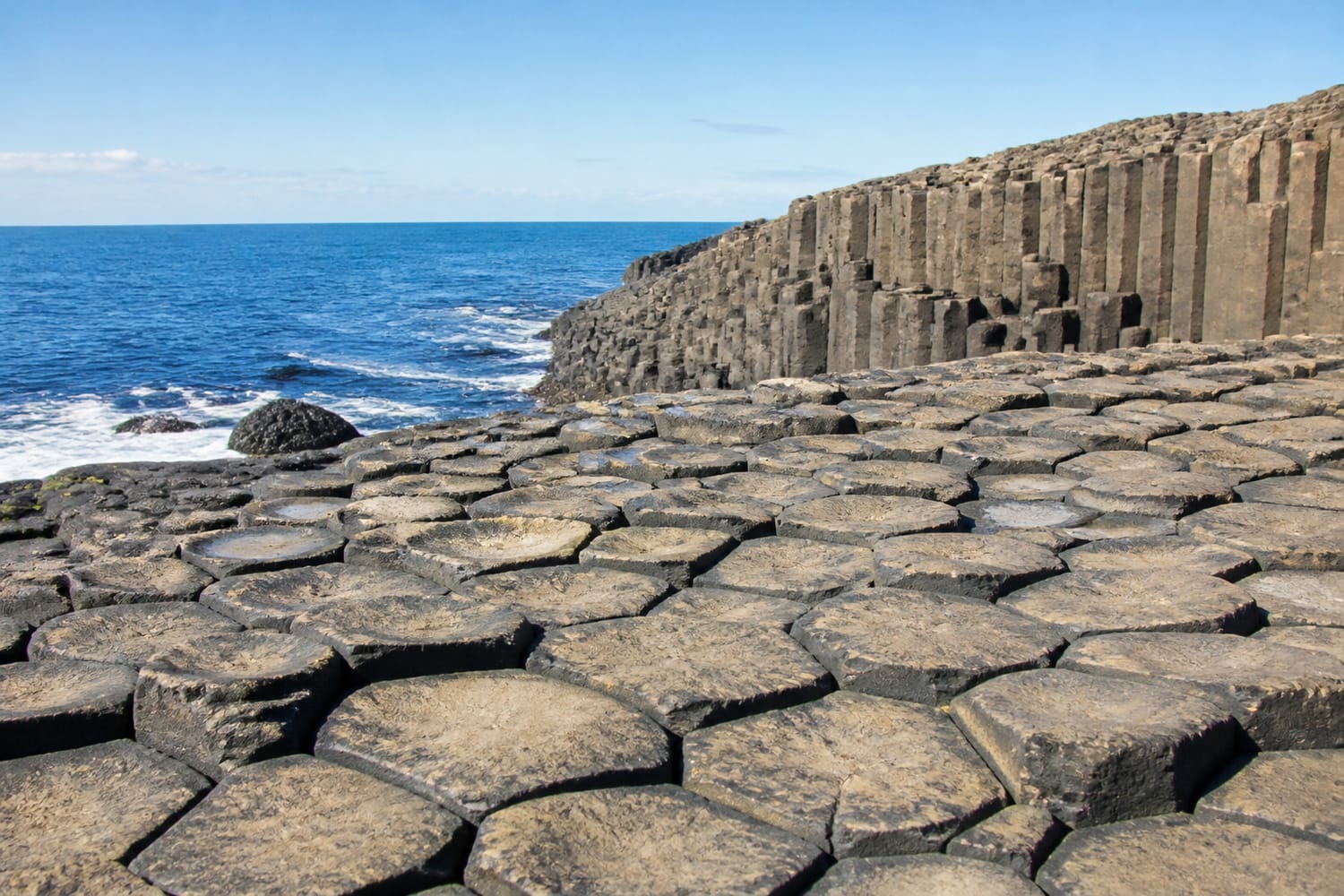
Look down at the exposed ends of a column field, and the shapes often resemble a honeycomb. Hexagons are common because a network of cracks meeting at roughly 120-degree angles relieves contraction stress efficiently. Repeated across a cooling surface, those intersections produce six-sided outlines.
But this is not a factory turning out identical pieces. Cooling conditions vary, and cracks do not always meet neatly. Alongside hexagons, you may spot five-sided columns, seven-sided ones, and shapes that resist easy counting. That slight irregularity is a useful clue: what looks like precision stonework from a distance becomes a much more complicated pattern up close.
Nor are the columns always the same width. Different cooling conditions can produce broader, more regular pillars in one part of a flow and narrower, more tangled fractures in another. A single cliff may preserve both patterns, as though the rock recorded changes in its own cooling history.
Why Do the Pillars Stand Upright?
The columns usually form at right angles to the surface from which the rock loses heat. In a lava flow with a broadly level top and bottom, that commonly means nearly vertical pillars. The fractures extend through the flow while the columns stand side by side, giving a cliff face the appearance of a row of oversized posts.
“Usually” matters here. If rock cools against a sloping surface or along the side of a flow, columns can tilt or curve. Follow their direction with your eye, and a seemingly decorative pattern becomes a clue to where heat escaped. The stones are not arranged to face a viewer; their orientation reflects the conditions under which they formed.
Cooling Builds Them; Erosion Reveals Them
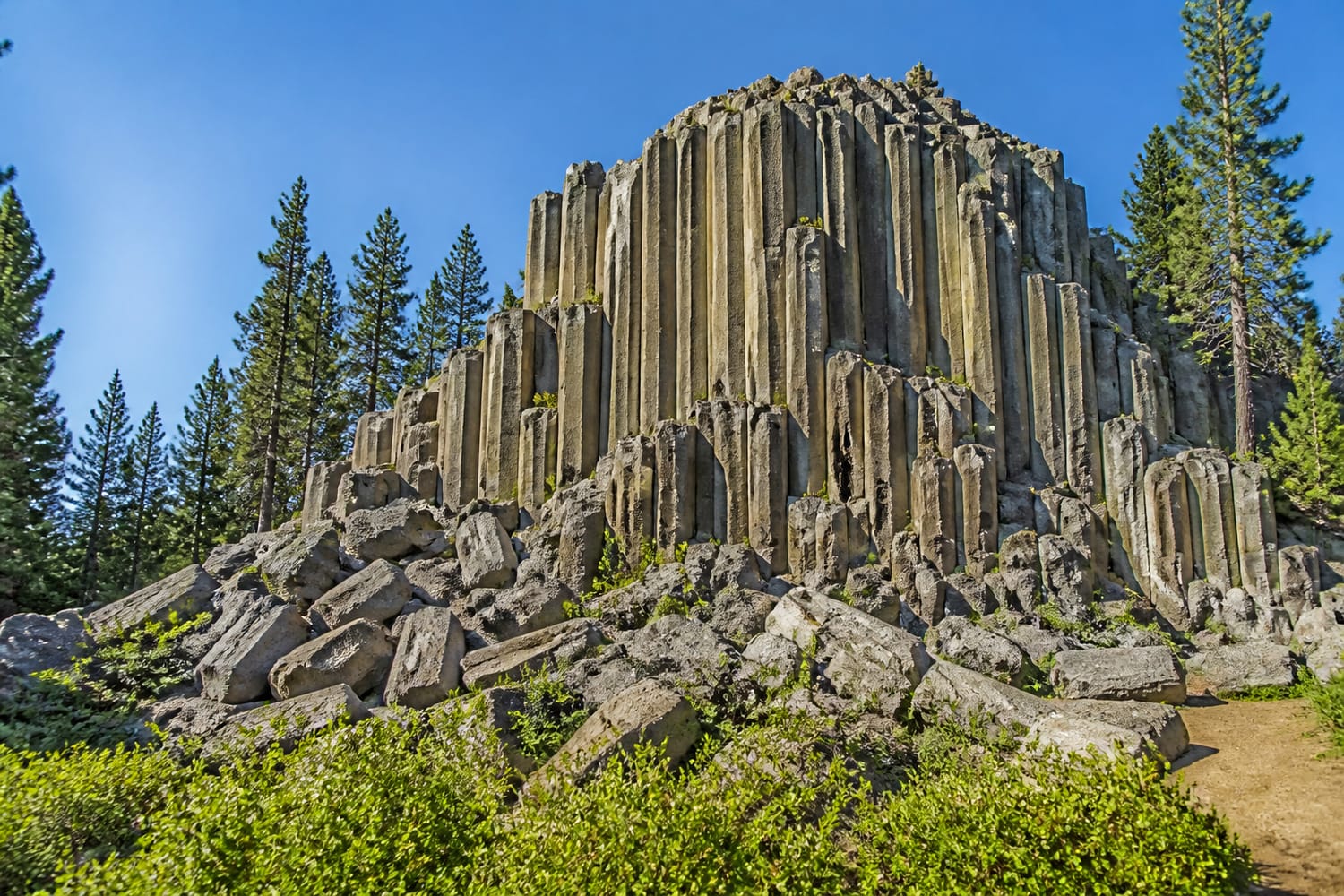
Cracking creates the columns, but it does not necessarily put them on display. At first, the joints may remain inside a much larger body of rock. Rivers, waves, glaciers, and weathering can later remove surrounding material or pry loose blocks along the fractures.
That distinction explains why a column-lined coast or cliff can have two stories. Fire shaped the rock’s internal pattern; erosion uncovered it. The same joints that gave the columns their outlines also offer places where water and ice can work their way into the stone.
California’s Devils Postpile shows this partnership clearly. Lava cooled and fractured into remarkably straight columns, and later glaciers exposed the formation. Ice also polished the tops of some columns, making their polygonal ends easier to see. The National Park Service’s guide to columnar jointing describes the fractures behind the pattern and examples in U.S. parks.
Giant’s Causeway: A Pavement Fit for a Legend
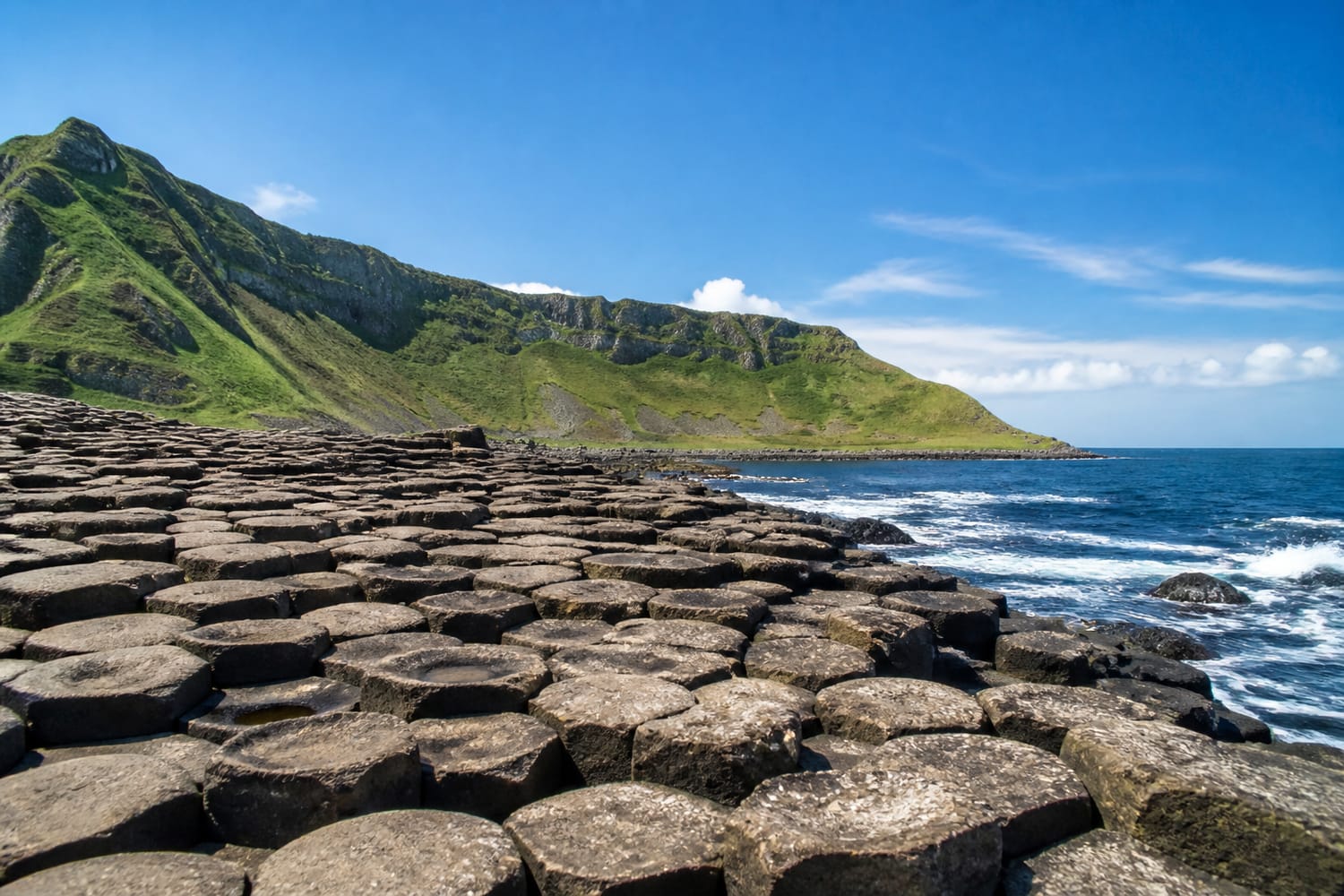
On Northern Ireland’s coast, the Giant’s Causeway turns the geometry into a landscape. Around 40,000 interlocking basalt columns meet the sea, with many exposed ends forming a remarkable stone pavement. It is easy to see why the site inspired a story about a giant building a route toward Scotland.
The geological explanation is no less striking. Volcanic activity laid down the rock roughly 60 million years ago; cooling and contraction formed the columns. The sea and erosion helped reveal the arrangement visitors recognize today. UNESCO’s Giant’s Causeway and Causeway Coast profile places both the columns and their legend in context.
For more places that seem designed rather than discovered, Tour Trivia explores landmarks built by nature itself. Giant’s Causeway is a particularly good reminder that a tidy-looking pattern need not have a human designer.
How to Read a Column-Clad Cliff
If you encounter columnar rock, try looking at it in two directions. From the side, follow the pillars to see whether they run straight, lean, or curve. From above—where a safe, permitted viewpoint allows it—look for the polygonal pattern across their ends. A wall of posts and a floor of tiles may be two views of the same fractured rock.
Then look beyond the most orderly patch. Are there broken columns at the cliff’s base? Does a more irregular band sit above the straighter pillars? Those details help separate the original cooling pattern from the later erosion that brought it into view.
The contrast with human stonework makes the sight even more memorable. People can carve columns from rock, as in Tour Trivia’s look at landmarks carved from a single piece of stone. Columnar joints work the other way around: the rock divides itself into apparent building blocks.
Nature’s Architecture, Written in Cracks
These giant columns are not stones stacked one at a time. They are the surviving pieces of a once-connected mass, outlined as heat escaped and exposed as the landscape changed. Their repeated shapes make them look engineered, while their odd angles and uneven sides preserve the evidence of a natural process.
That is the trick behind the illusion. Cooling lava supplies the geometry; erosion opens the gallery. What appears to be an ancient construction project is really a record of molten rock becoming stone.