
A Tree That Starts Above the Ground
“Strangler fig” describes a growth strategy shared by multiple species in the genus Ficus, rather than one particular tree. These figs occur in tropical and subtropical regions, with examples found from South Florida to Africa and Australia.
Their beginnings are surprisingly modest. A fruit-eating bird may leave a seed in its droppings, depositing it in a branch fork or bark crevice. Where moisture and decomposing plant material collect, that unlikely nursery can support a seedling far above the forest floor.
Starting overhead helps the young fig reach sunlight without first growing through the shaded understory. It initially lives as an epiphyte—a plant growing on another plant for support. Unlike a true feeding parasite, it does not tap directly into its host’s tissues to steal nourishment. The borrowed tree is scaffolding, not a meal.
How the Slow-Motion Takeover Works
As the seedling develops, slender aerial roots descend toward the soil. Once established in the ground, they gain access to additional water and nutrients, thicken, and form an increasingly substantial framework around the host. Roots can join together, creating a network that resembles a woven wooden cage.
Meanwhile, the fig expands upward and outward. Its foliage competes with the supporting tree for sunlight, while underground roots compete for resources. The enclosing root network may also interfere with the host’s growth and the transport of water and nutrients through its outer tissues.
This is why “strangling” is an evocative but incomplete description. The outcome involves several pressures operating together, not simply one tightening root. There is no deliberate attack and no digestion of the other tree—just an unusually effective way of competing for space and resources.
The Mystery of the Hollow Trunk
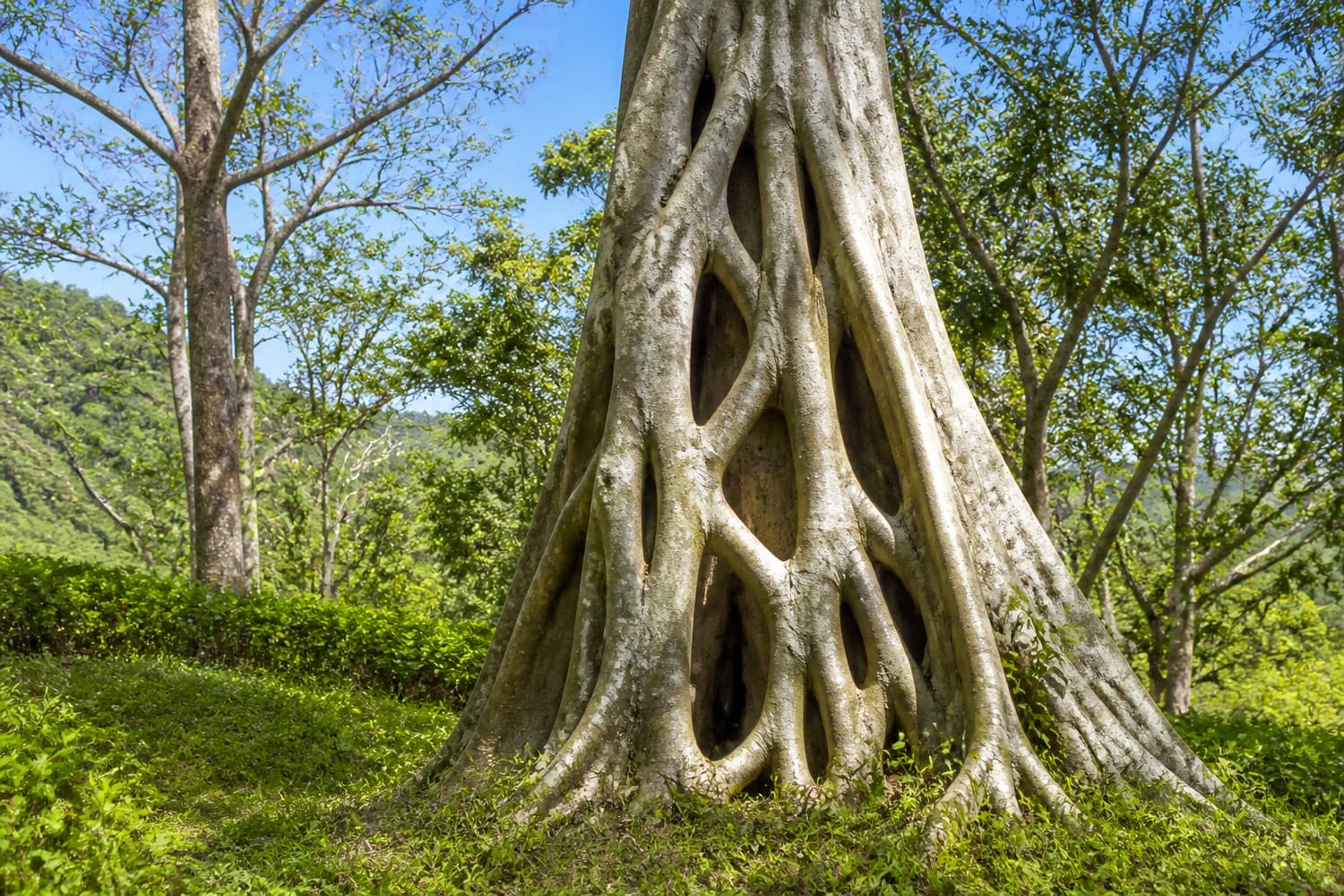
When a host dies and decomposes, the fig’s surrounding framework can remain standing. What looks like an enormous, strangely perforated trunk may actually be a network of partly fused roots surrounding the space where another tree once grew.
That missing center is part of the fascination. Openings between roots reveal an architectural trick: the original support has disappeared, but the structure built around it survives. The fig has effectively replaced its starting platform with its own living framework.
Not every strangler fig follows this exact sequence. Some establish without a living host, including on rocks or directly in the ground. The Florida strangler fig, Ficus aurea, can grow from buried seeds as well as from seeds lodged in another tree. Its dramatic name describes a familiar possibility, not an unavoidable destiny.
A Giant Tree With a Tiny Partner
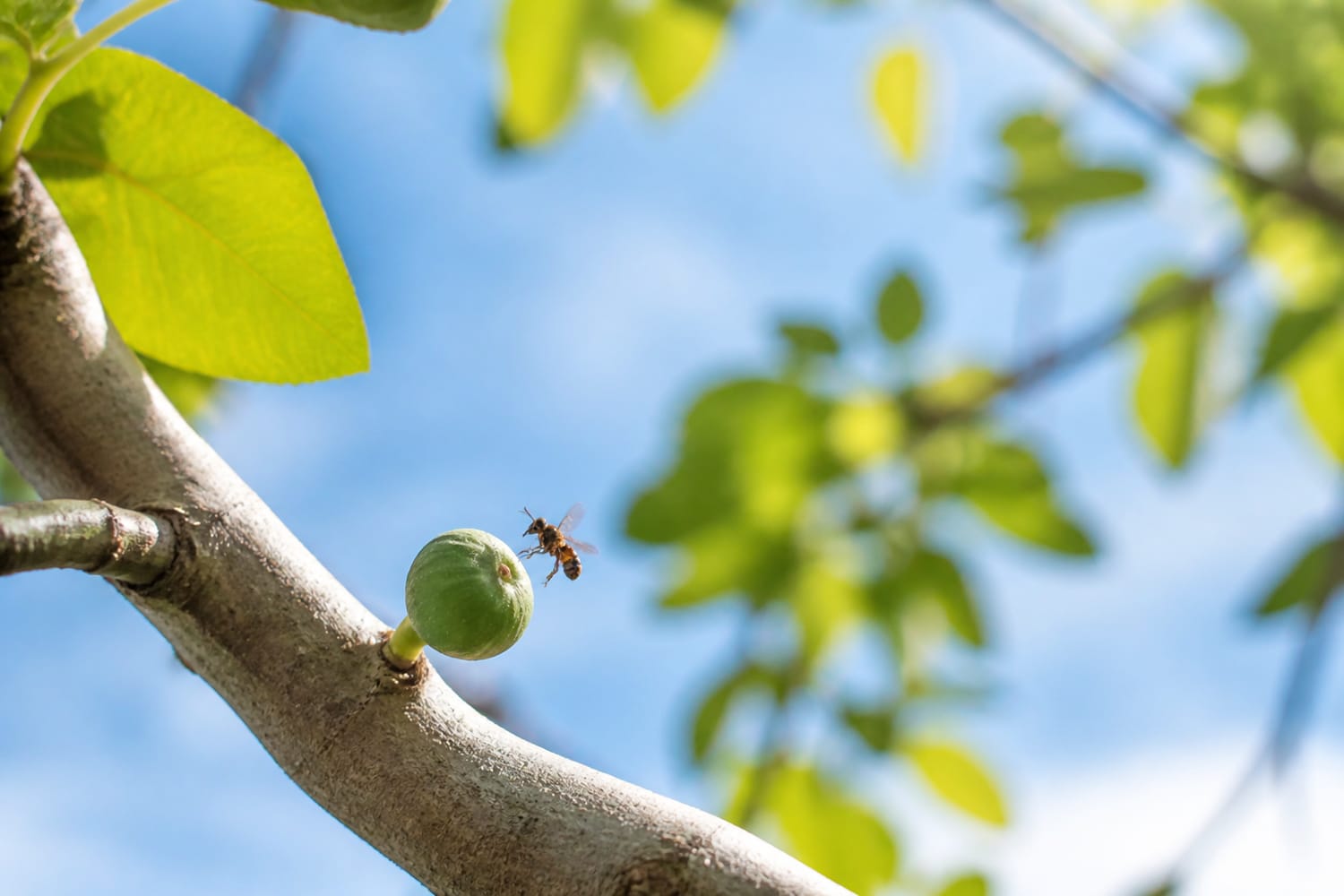
For all their imposing roots, figs depend on remarkably small collaborators. Their flowers are hidden inside an enclosed structure called a syconium—the structure we casually call a fig. Pollinating fig wasps reach those flowers through a tiny opening.
A female wasp carries pollen into a receptive fig and lays eggs in some of its flowers. Her offspring develop inside, and the next generation of females eventually leaves carrying pollen to other receptive figs. The plant gains pollination; the wasps gain a nursery.
These relationships can be highly specialized. Kew’s Florida strangler fig profile identifies Pegoscapus mexicanus as that species’ pollinator. It is a wonderful reversal of scale: an immense tree’s reproductive future rests with an insect most visitors would scarcely notice.
More Than a Forest Villain
Strangler figs provide food and shelter well beyond their relationship with a host. Their fruits feed wildlife, while hollow interiors offer habitat for animals including bats and birds. Those benefits help explain why figs are often described as keystone resources in tropical forests.
Timing matters, too. Florida strangler figs do not all fruit simultaneously, making their crops a valuable food supply across the landscape, including for migrating songbirds. The same animals that eat the fruit can help disperse seeds, beginning another canopy-level life cycle.
There is even a surprising twist to the supposedly doomed partnership. As Kew explains in its examination of strangler figs and storms, observations following a cyclone in Australia suggested that attached figs may help hosts remain standing. Their roots can act as bracing, although that does not mean every association benefits the host overall.
Where the Roots Become a Landmark
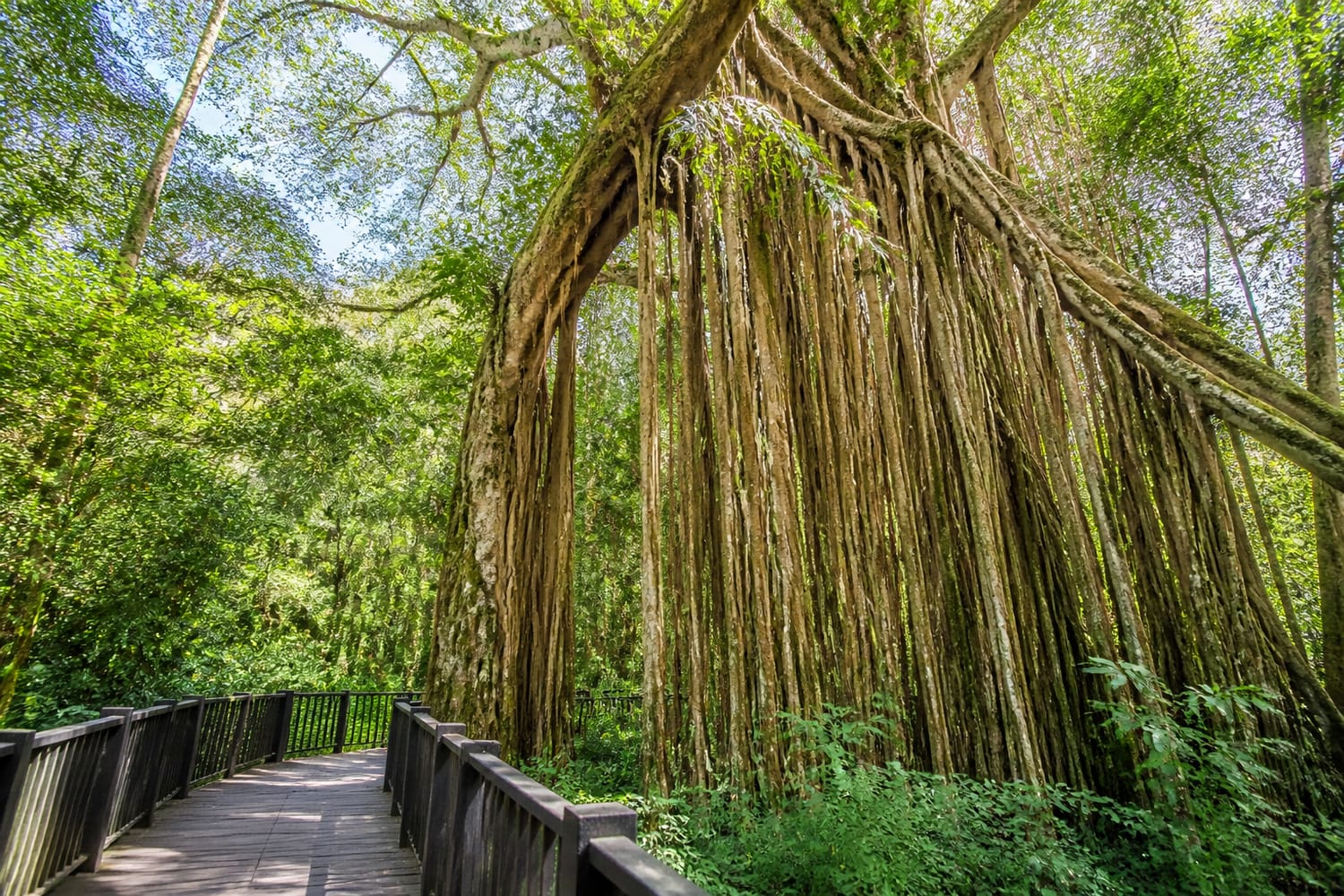
One spectacular example stands near Yungaburra in Queensland, Australia. At Curtain Fig National Park, a massive strangler fig displays aerial roots dropping roughly 15 meters—about 49 feet—to the forest floor. The tree is estimated to be more than 500 years old.
Its unusual curtain developed after a supporting tree leaned into a neighboring tree, allowing new roots to descend along the tilted structure. An elevated boardwalk now lets visitors view the formation while protecting its roots. Stay on that designated route rather than stepping into the root network.
If centuries-old trees capture your imagination, Tour Trivia’s guide to the world’s oldest trees offers another way to explore their remarkable lives.
Look Beyond the “Swallowing” Story
The best question to ask beside a strangler fig is not simply, “What did it kill?” Look for where roots descend, where neighboring strands have fused, and whether a separate host remains visible. Those details reveal its growth history more clearly than its fearsome nickname.
For another botanical surprise, explore why rainbow eucalyptus trees look painted. Both invite a closer look. A strangler fig may resemble a monster swallowing a tree, but its real story—competition, cooperation, and transformation—is stranger than the metaphor.