
From Seafloor to Stone
The story begins underwater, long before the mountain existed. When marine animals died, their shells and other hard parts could become buried in accumulating sediment. Burial helped protect those remains from scavengers, disturbance, and decay, improving their chances of entering the fossil record.
As more sediment accumulated, the lower layers became compacted and cemented into sedimentary rock. Some shells survived in altered form; others dissolved, leaving hollow molds. Those spaces could later fill with minerals or sediment, creating casts that preserved the original shell’s shape.
This means a mountain “seashell” is not necessarily an intact shell like one collected on a beach. It might be a mineral replacement, an impression, or a cast. The Natural History Museum’s explanation of how fossils form shows how these different routes preserve evidence of ancient life.
How an Ocean Floor Becomes a Mountain
Earth’s outer rocky shell is divided into tectonic plates that move slowly relative to one another. Where plates converge, rocks can be compressed, folded, fractured, and pushed upward. Continental collisions can build enormous mountain ranges, carrying formerly submerged sedimentary layers high above sea level.
Picture pushing the ends of a rug together: the material wrinkles upward rather than remaining flat. Mountain building is much more complicated, but the comparison helps explain how horizontal layers can become tilted and folded during compression.
The important distinction is that the fossils travel with the rock. Sea creatures did not climb the mountain, and waves did not have to wash over an already towering summit. The rock containing their remains changed position after it formed beneath the sea.
Everest’s Remarkably Watery Beginning
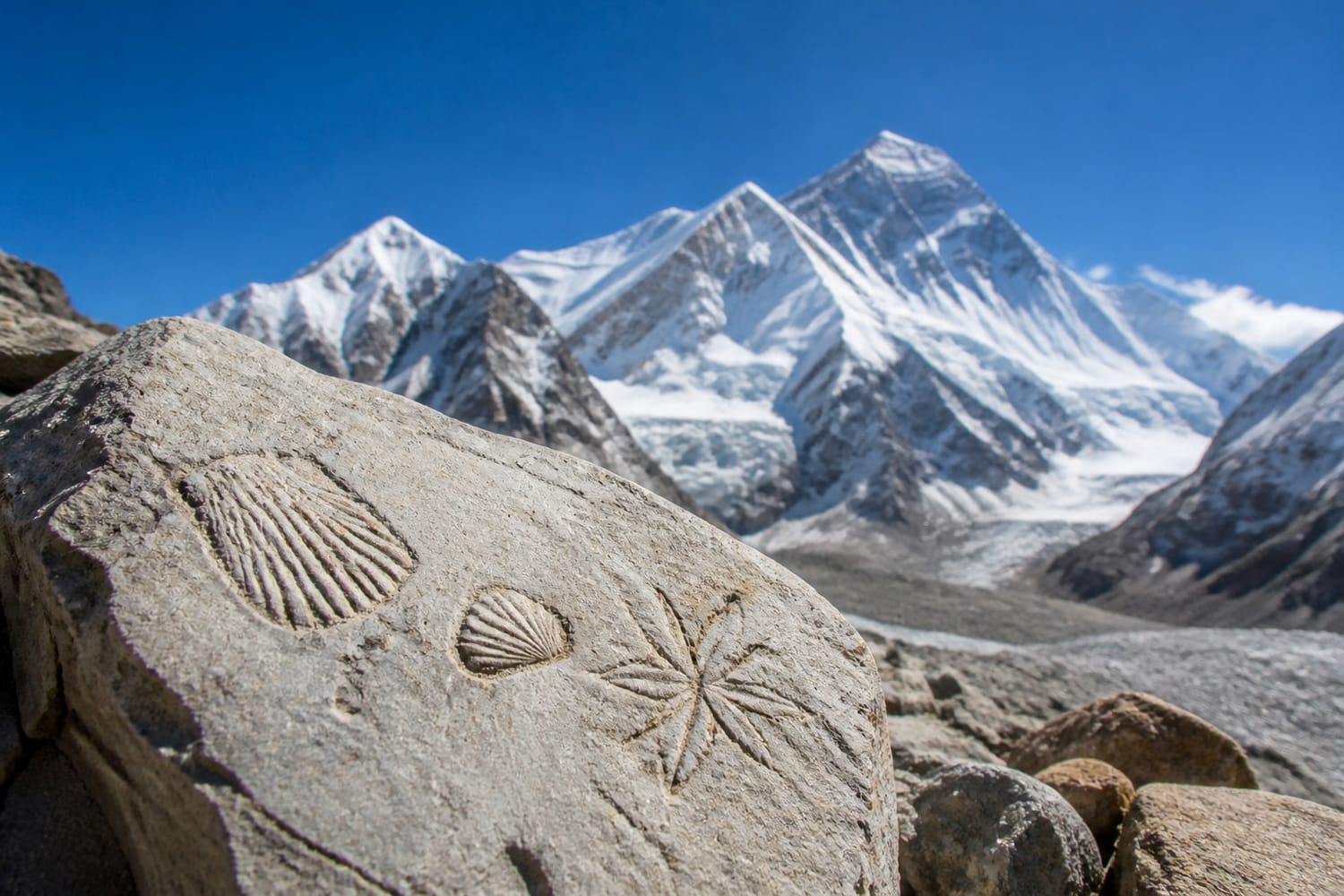
Mount Everest provides perhaps the most spectacular example. Its summit rocks include marine limestone deposited in a warm, shallow sea roughly 450 million years ago, during the Ordovician Period. Those rocks contain fossils of marine organisms, including brachiopods and crinoids.
Much later, India’s collision with Asia—beginning around 55 million years ago—helped lift and deform ancient marine rocks into the Himalayas. The International Union of Geological Sciences describes these extraordinary fossil-bearing rocks of Mount Everest.
Here is the mind-bending part: the summit limestone is vastly older than the mountain-building collision that raised it. A rock’s age tells us when it formed, not when it reached its present elevation. Everest’s highest rocks had already existed for hundreds of millions of years before Himalayan mountain building began.
Not Every “Seashell” Is a Shell
Marine fossils include much more than familiar-looking clams and snails. Some belong to animals with no obvious counterpart in a beachcomber’s collection. Recognizing a few common forms makes the ancient ocean easier to imagine.
- Brachiopods have two shells and can resemble clams, but belong to a different animal group.
- Crinoids, sometimes called sea lilies, are animals related to sea stars. Fossil stem pieces can resemble tiny disks or stacked coins.
- Corals may preserve evidence of colonial or solitary marine animals.
- Trilobites were segmented marine animals whose fossilized body parts occur in many ancient rocks.
A small circle or ribbed impression may therefore represent something quite different from a modern seashell. Identification depends on its structure and the surrounding geology, not simply its resemblance to something familiar.
Ancient Seas Beyond the Himalayas
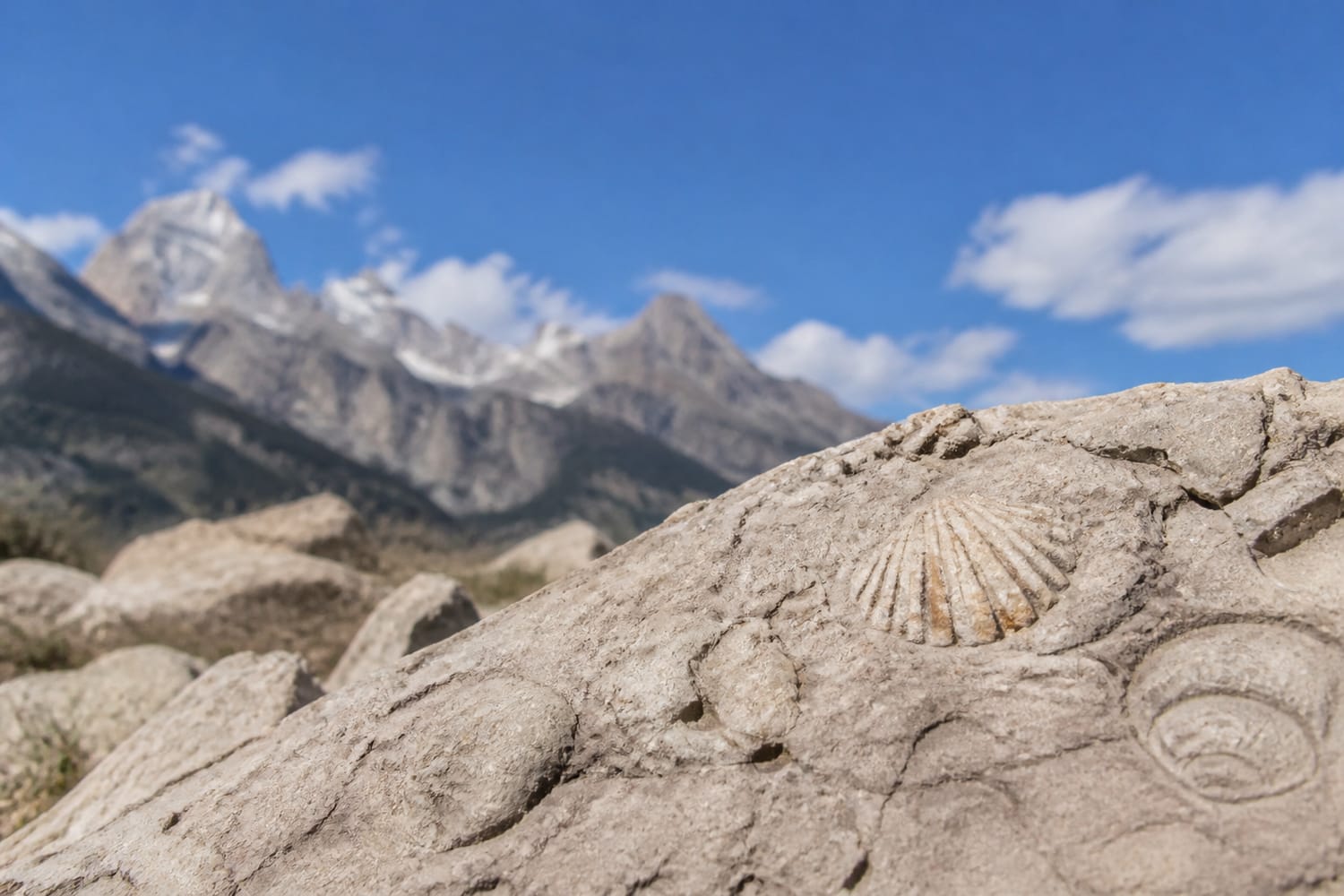
You do not need an Everest expedition to encounter this story. In Wyoming’s Grand Teton National Park, sedimentary formations preserve marine fossils that reveal an ancient seafloor where the mountain range now stands. These include corals, brachiopods, and trilobites.
Utah offers another illustration. Many rocks in its western desert formed in marine environments. Later uplift and erosion exposed those rocks and the fossils within them, bringing ancient sea life into a landscape now associated with dry valleys and rugged high ground.
These examples are reminders that today’s geography is only one chapter. A desert can preserve an ocean’s history, just as a snowy ridge can contain evidence of tropical marine habitats.
Why Erosion Deserves Some Credit
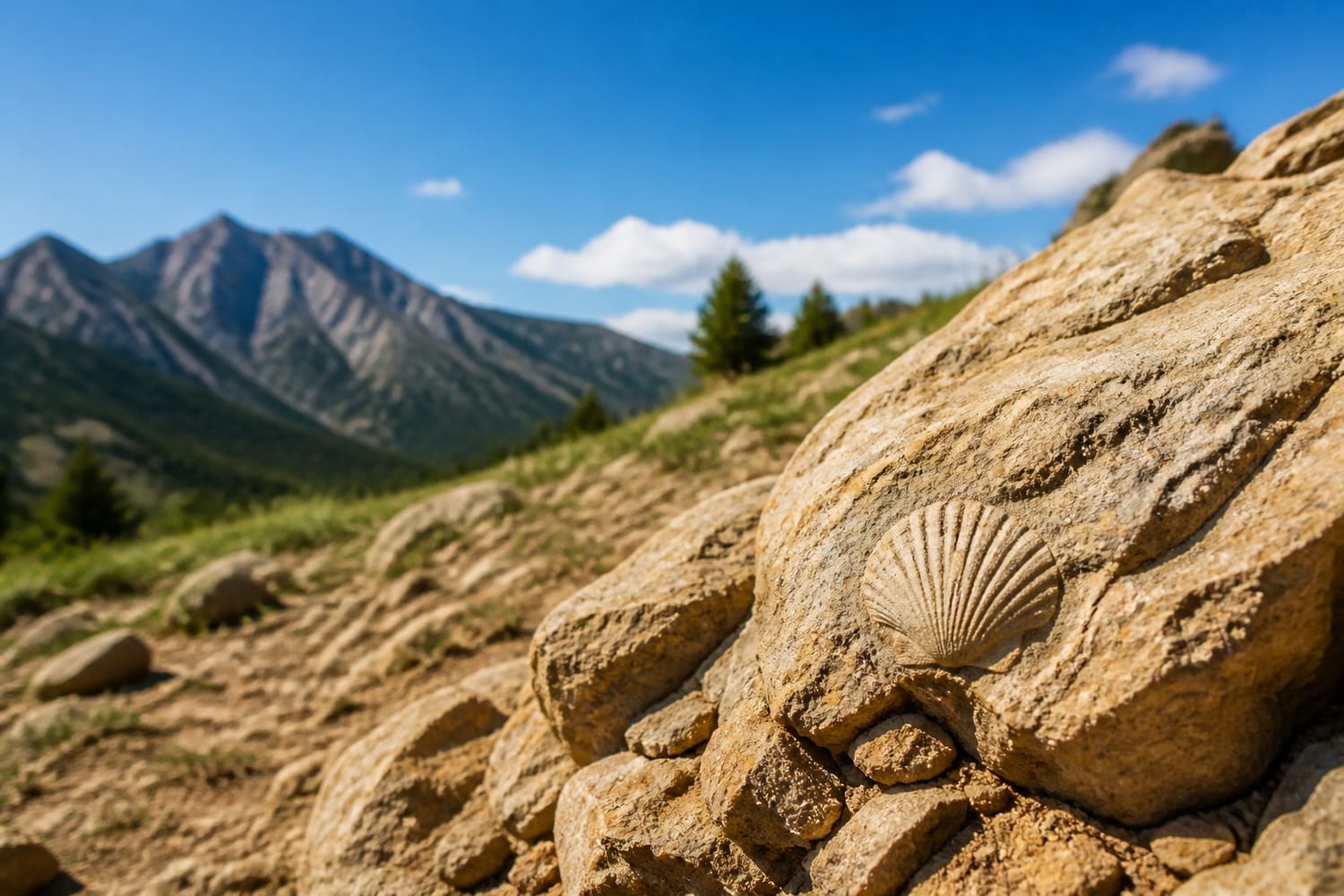
Uplift alone does not make buried fossils visible. Weathering breaks rock down, while erosion carries loosened material away. Together, these processes can uncover fossil-bearing layers that were previously hidden beneath other rock.
That creates an interesting partnership: geological forces raise the rocks, then surface processes reveal their contents. Erosion also reshapes the mountains themselves. Tour Trivia’s guide to why some mountains have flat tops explores another way the removal of rock makes an older landscape visible.
What These Fossils Actually Tell Us
Marine fossils in mountain rocks demonstrate that those rocks formed in a marine setting before reaching their present position. They do not, by themselves, mean the ocean once stood at the mountain’s current height. The land has moved, too.
Fossils also help geologists compare rock layers and establish their relative ages. Different organisms lived at different times, so particular fossil groups can help connect layers separated by considerable distances. A shell-shaped mark can therefore be both evidence of an ancient habitat and a tool for reconstructing geological history.
Leave the Discovery in Place
If you notice a possible fossil while hiking, resist the urge to pry it loose. Photograph it, record its location, and leave it undisturbed. In a U.S. national park, report the discovery to a ranger, following the National Park Service’s fossil conservation guidance.
Then take another look at the view. That ridge is more than a dramatic skyline: it may hold the remains of a vanished underwater world. The ocean is gone, but part of its story is still there beneath your feet.