
When Gravity Seems to Lose
An “upward” waterfall is not truly reversing its source or defeating gravity. Instead, powerful winds catch the falling water, break it into lightweight droplets, and push those droplets upward or back over the cliff. The spectacle is most likely where exposed cliffs, strong gusts, and relatively low-volume waterfalls meet.
Videos of these events can look impossible. A stream reaches the edge of a cliff, begins to descend, and then suddenly rises like smoke. Although commonly called reverse waterfalls, they are better understood as dramatic interactions between moving water, moving air, and the surrounding landscape.
Gravity Is Still Doing Its Job
Every waterfall begins the usual way: gravity pulls water from higher ground toward lower ground. Once the stream passes over a ledge, it accelerates downward, converting gravitational potential energy into motion.
Wind does not switch off that process. At the lip of the waterfall, the water still starts falling. What changes is the path it follows after entering the air.
If the descending stream remains thick, cohesive, and fast, wind may only bend it slightly. If it separates into spray, however, the air can redirect much of the visible water. Some droplets may travel sideways, while others may be carried upward or blown back onto the plateau.
This is similar to watching rain move almost horizontally during a storm. Gravity continues pulling every drop down, but powerful air currents can dominate its short-term motion.
Why Droplets Are Easier to Lift
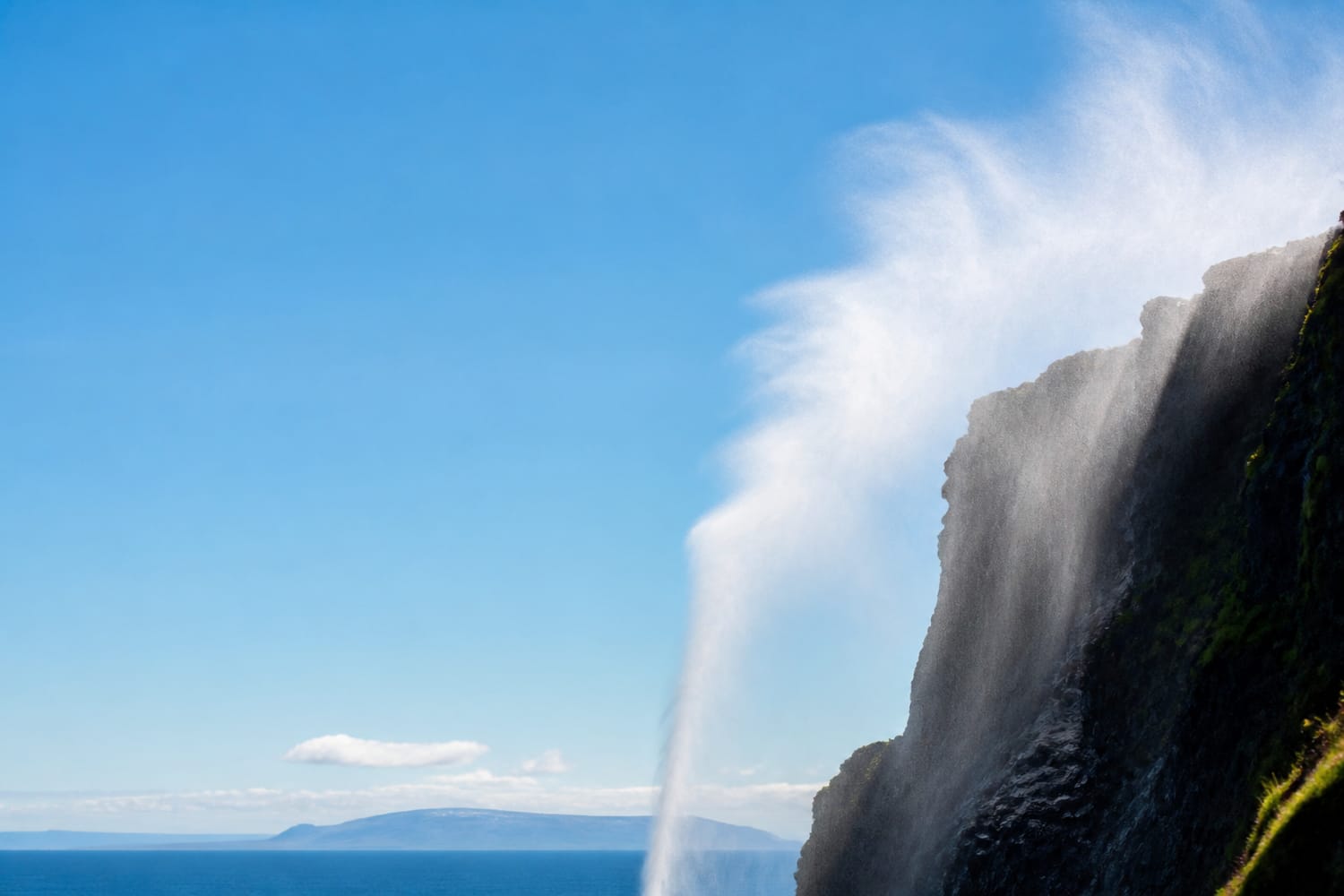
A continuous stream of water has considerable mass and momentum. Strong wind cannot easily pick up the entire body of a large, fast-flowing waterfall. That is why massive cascades rarely appear to reverse, even in stormy weather.
Once the water breaks into droplets, the situation changes. Small droplets have a high surface-area-to-mass ratio, meaning a relatively large portion of each droplet is exposed to the wind. Air resistance can then have a much greater influence on its direction.
Several factors determine how dramatically the water moves:
- Droplet size: Fine mist is easier to lift than large drops.
- Water volume: A thin waterfall is more vulnerable to wind than a heavy torrent.
- Wind speed: Stronger gusts exert greater force on the spray.
- Exposure: Coastal and mountaintop cliffs often receive unobstructed winds.
- Fall height: Longer drops give water more time to fragment and interact with the air.
A waterfall does not need to be pushed upward as one solid stream. It only needs to become fine enough for countless droplets to be transported together, creating the appearance of a rising cascade.
How Cliffs Create Updrafts
The shape of the landscape is often as important as the speed of the wind. When horizontal wind strikes a steep cliff, the air cannot pass through the rock. It must move around the obstacle, and some of it is forced upward.
These rising currents are known as updrafts. Near a cliff edge, they can meet falling spray almost head-on. If the upward-moving air is strong enough, it catches the droplets and sends them back toward the top.
Irregular rock faces can also generate turbulence—swirling, rapidly changing air currents similar to eddies in a river. One gust may bend a waterfall sideways, while the next sends a cloud of spray vertically into the sky.
Wind itself forms as air moves between areas of different atmospheric pressure, as explained in the Met Office guide to wind. Mountain slopes, valleys, coastlines, and cliffs then reshape that airflow on a local scale.
Why Thin Waterfalls Produce the Best Illusion
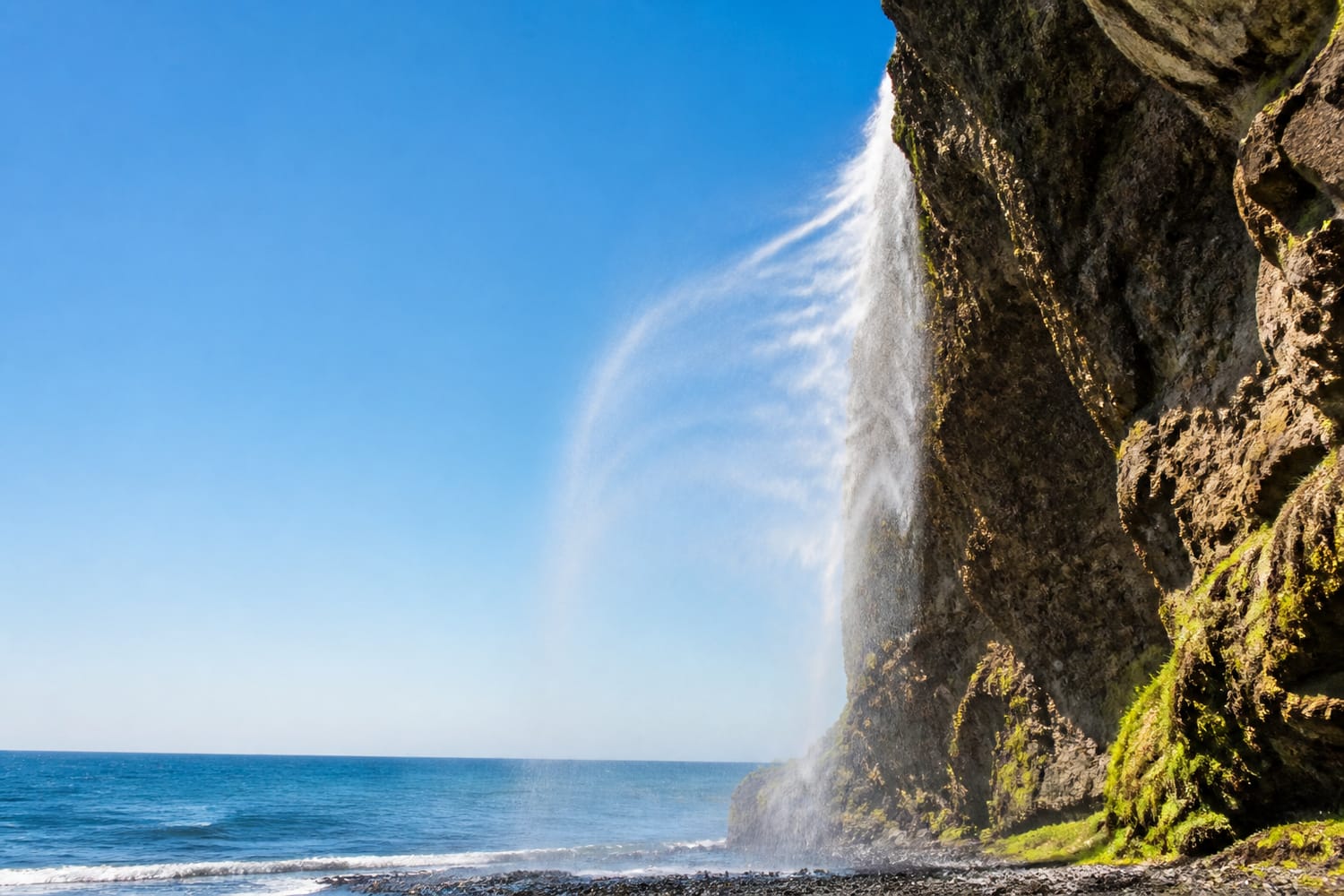
Not every waterfall can put on this performance. Niagara Falls, for example, carries far too much fast-moving water for an ordinary gust to lift the entire cascade. Reverse-waterfall spectacles usually involve narrower streams that become mist soon after leaving the cliff.
Seasonal waterfalls can be particularly responsive. After light or moderate rain, they may carry enough water to remain visible but not enough to resist powerful winds. Tall, veil-like falls are also good candidates because the stream has time to separate into drops.
This same combination gives many delicate waterfalls their constantly shifting appearance. Yosemite’s 620-foot Bridalveil Fall is known for its light, swaying flow outside the strongest spring runoff period. The National Park Service’s Bridalveil Fall guide also warns visitors to expect heavy spray when the waterfall is flowing strongly.
Water and wind have shaped far more than waterfalls. Tour Trivia’s look at natural bridges and rock arches explores other landscapes sculpted by the patient action of weather, erosion, and gravity.
Famous Places to See the Phenomenon
The Faroe Islands are closely associated with images of waterfalls being swept upward. These exposed North Atlantic islands experience powerful winds, and their coastal waterfalls frequently descend from steep sea cliffs. During severe gusts, the falling water may turn into spray before reaching the ocean and be blown back toward the land.
Brazil’s Cachoeira da Fumaça, whose Portuguese name means “Smoke Waterfall,” offers another striking example. Its water becomes a drifting cloud of fine droplets, giving the cascade a smoky appearance before it reaches the bottom.
Windblown waterfalls have also been observed in the United Kingdom, Iceland, India, Australia, and Hawaii. The shared ingredients are remarkably consistent: exposed terrain, a high cliff, strong winds, and water light enough to fragment.
These places belong to a broader collection of landscapes that seem invented. Other examples appear in Tour Trivia’s guide to the strangest landmarks built by nature.
Is It Partly an Optical Illusion?
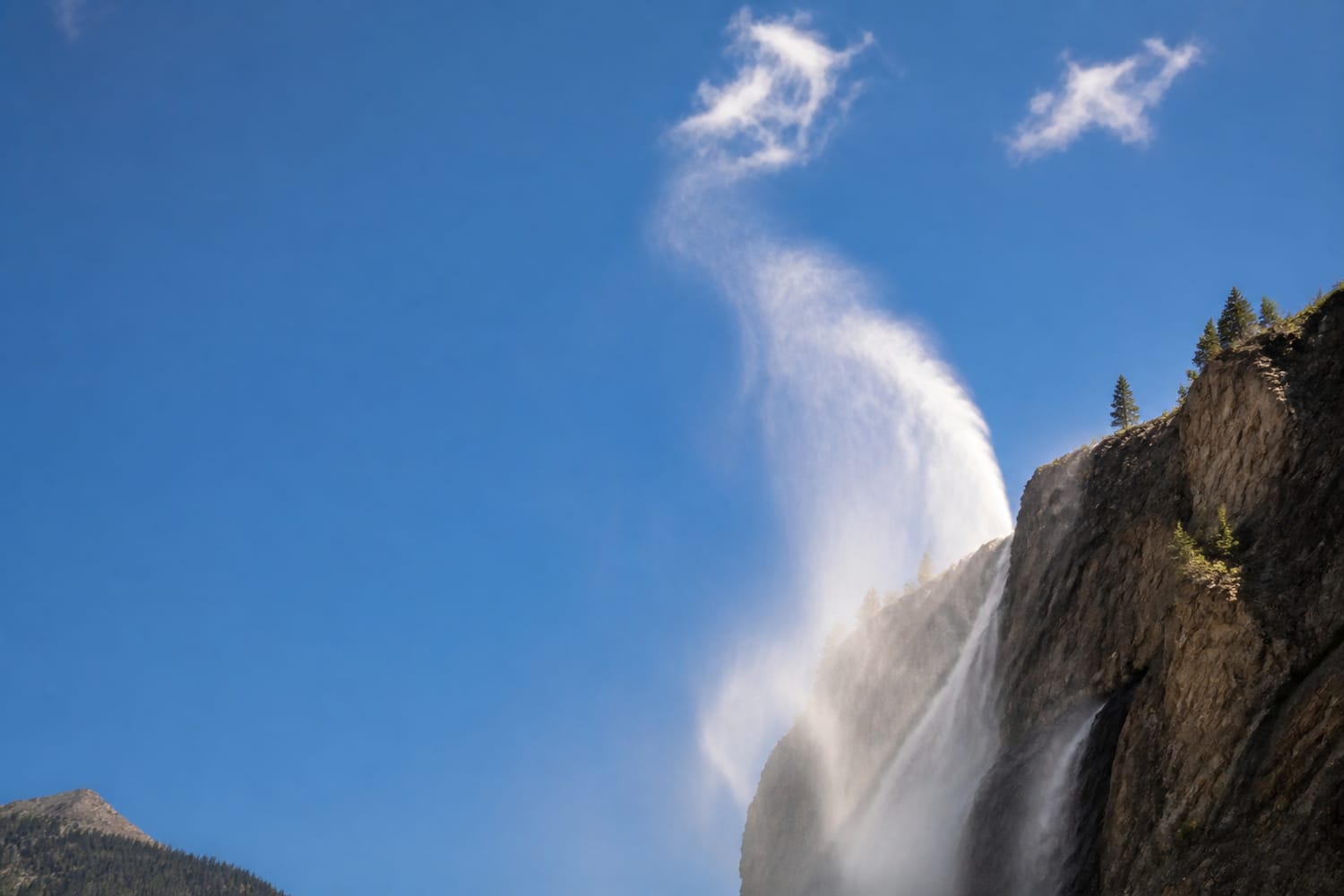
The water’s upward movement is real, but perspective can exaggerate it. From a distant viewpoint, observers may not see the thin stream beginning to descend. They primarily notice the larger, brighter cloud of spray rising above the cliff.
Video can strengthen the illusion by flattening depth. Water moving diagonally toward the camera may appear to travel vertically. Zoom lenses compress the scene, making separate layers of falling water and rising mist look like one continuous stream.
Lighting matters too. Backlit spray can glow brightly, while the original descending flow blends into dark rock. The most visible part of the waterfall is therefore the section being carried upward.
When Is an Upward Waterfall Most Likely?
Travelers hoping to witness the spectacle should look for a specific combination of conditions:
- A tall, narrow, or seasonal waterfall
- Strong winds blowing toward the cliff
- An exposed coastal or mountainous setting
- Moderate rather than exceptionally heavy water flow
- A safe viewpoint facing the waterfall from a distance
Stormy conditions may increase the chances, but they also create serious hazards. Wet rocks become slippery, sudden gusts can affect balance, and airborne spray may reduce visibility. Visitors should remain on marked paths, obey closures, and never approach an exposed cliff edge for a better photograph.
Nature’s Tug-of-War
An upward waterfall is not a loophole in physics. It is physics on display. Gravity pulls the water down, while aerodynamic drag, turbulence, and terrain-driven updrafts push its smallest droplets in another direction.
The result lasts only while the right conditions overlap. When the gust weakens, the waterfall drops normally again. That fleeting quality is part of the wonder: for a few remarkable moments, wind becomes visible through water, and one of nature’s most familiar sights appears to turn itself upside down.